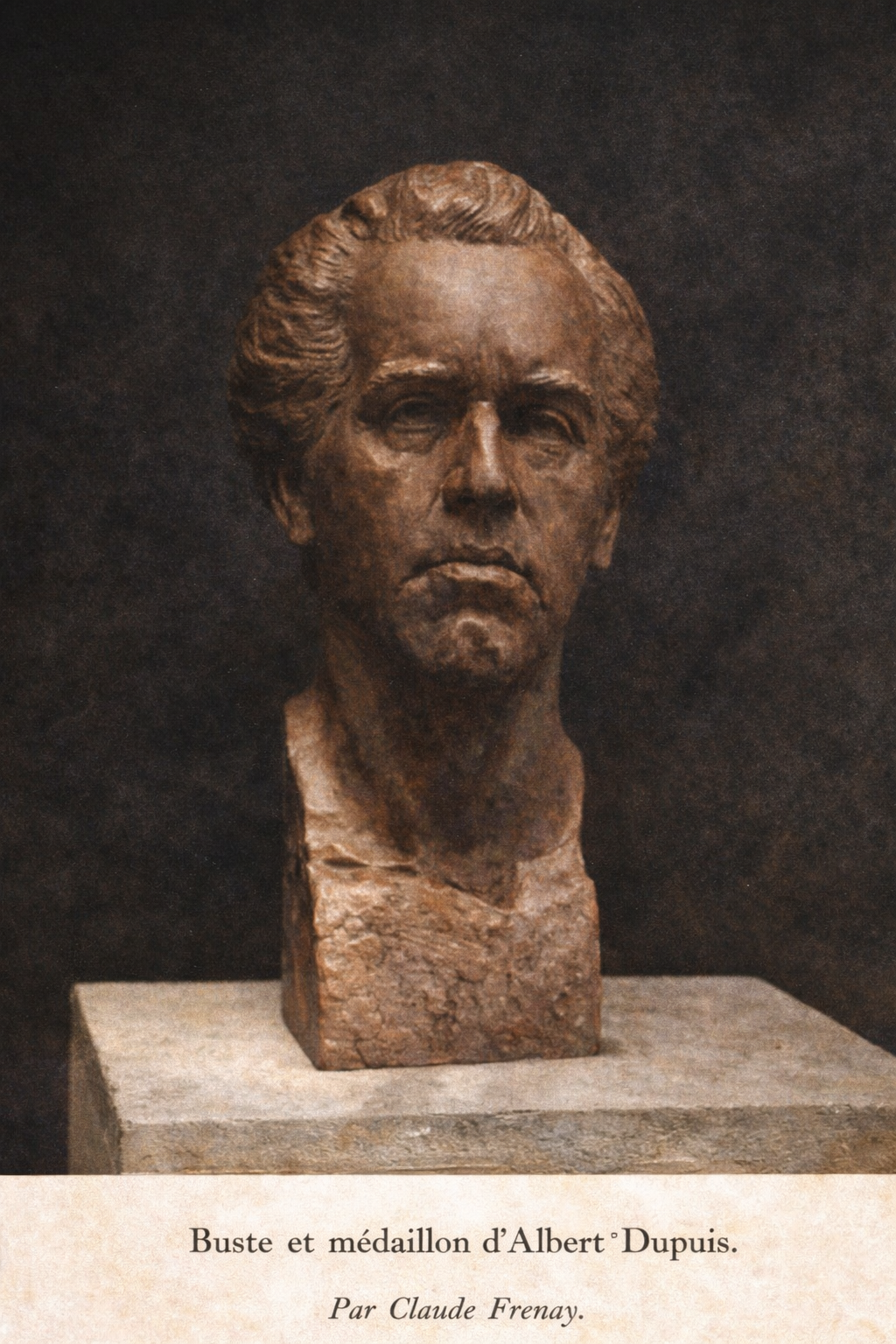
Biography
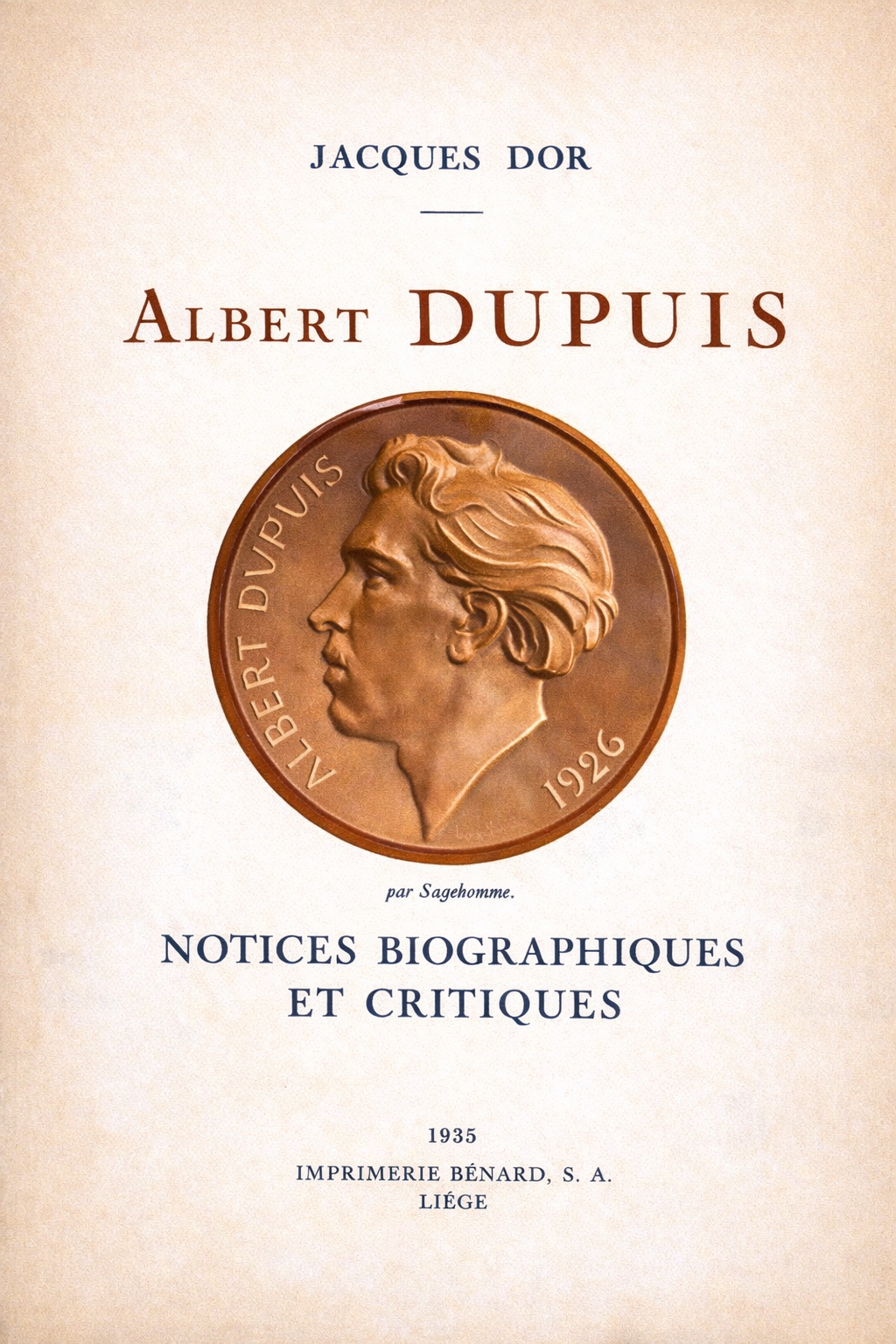
JACQUES DOR Biographical and Critical Notes 1935 Bernard Printing House, Liège
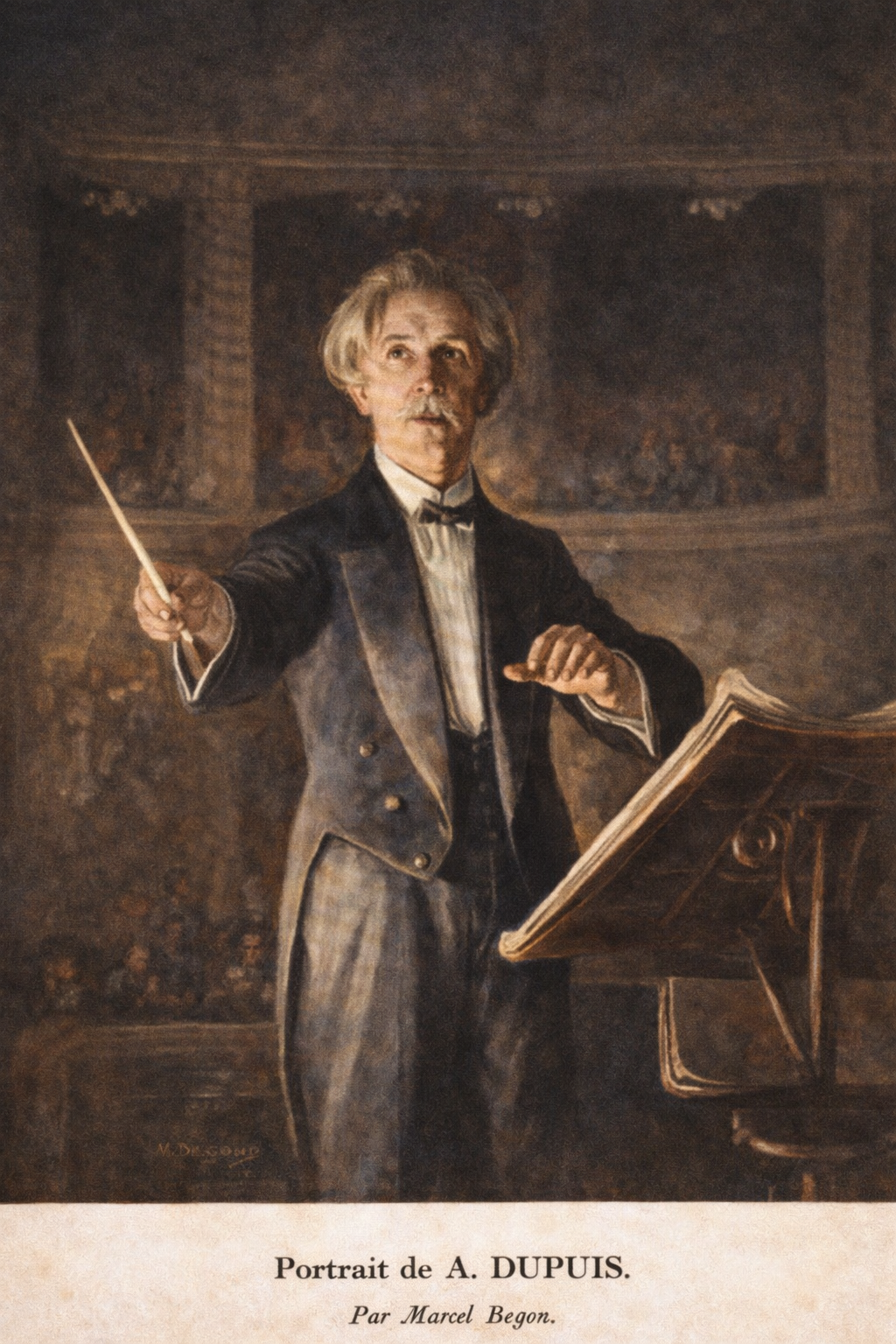
Albert Dupuis was born in Verviers on March 1, 1877. His father, Guillaume Dupuis, was a music teacher at the Royal Athénée of Verviers. From a large family of eight children, among whom Albert Dupuis was one of the youngest, most seem to have inherited the musical dispositions of their father and, with varying fortunes, pursued careers in this art. It is worth mentioning here the eldest of the children, Julien Dupuis, who, after brilliant studies at the Conservatory of Cologne, traveled for a long time as a conductor before settling in Lille, where he was appointed professor at the Conservatory and where he founded the Concerts that bear his name. Albert Dupuis entered the Conservatory of Music of Verviers at around the age of eight, and he made rapid progress. He devoted himself to the study of the piano, the violin, and the flute. He was only fourteen when one of the most unfortunate events—the death of his father—came to place obstacles in the way of his musical development that could have been fatal to him. His mother was forced to leave for America; young Albert, guided perhaps already by an obscure instinct of the future, insisted on not following her and on remaining to succeed. He was taken in by one of his relatives.
-9-
But she had only limited means, and Albert Dupuis, to help as much as he could with the needs of the small household, began to give music lessons and, soon after, was engaged as a pianist at the Grand Theatre. He was then barely fifteen years old. He thus began very young the difficult struggle for existence, but his musical talent had already developed remarkably, and as he possessed exceptional powers of assimilation, he was able to continue his studies alongside his small professional activities. It was around this time that François Duysings, professor at the Conservatories of Liège and Verviers, having discovered in the young musician a nature of exception, began to take an interest in him and generously offered to initiate him into the technique of harmony. One can judge the rapidity of his progress and his musical development from the fact that his first theatrical work dates from this period: he was only eighteen when the Theatre of Verviers staged an opera-comique in one act of his composition, entitled Ydille. But destiny, which was favorable to him at that moment, placed on his path the decisive event, the one that would definitively orient his destiny and, by removing him from a small provincial town where his talent would have lacked the atmosphere necessary for its flourishing, and by placing him under the direction of one of the most eminent composers of the time, would set him firmly on the path to success.
-10-
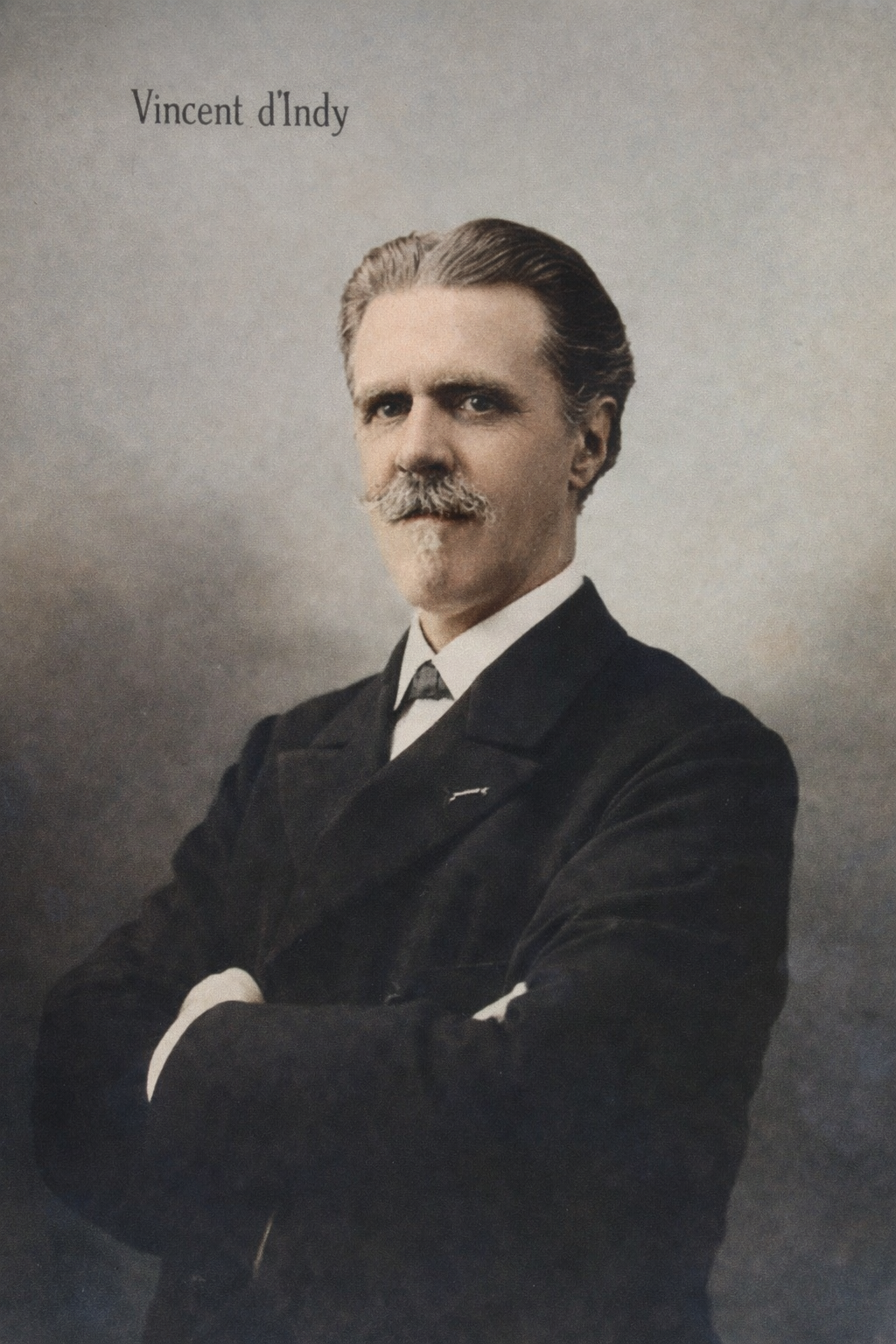
In 1896, the Royal Society “L’Emulation” of Verviers gave a performance of Chant de la Cloche by Vincent d’Indy, a performance which the composer himself attended. The young Albert Dupuis was presented to the master Vincent d’Indy; the latter examined his first compositions with keen interest and proposed that he go to Paris to work under his direction at the Schola Cantorum, which he had just founded. Shortly afterward, thanks to the intervention of a generous patron, Mr. Edmond Bastin of Verviers, this project was realized, and in January 1897 Albert Dupuis finally left for Paris. He enrolled immediately at the Schola Cantorum of Vincent d’Indy, where he studied alongside Paul Jumel, Gustave Doret, Déodat de Séverac, G. Mariotte, Seriex, Roussel, Gustave Bret, and Wittkowsky, among the first pupils of the master. Albert Dupuis, settled in Paris, did not limit himself solely to the course of musical composition with Vincent d’Indy; he also studied practical harmony with de la Tombelle, organ with Guilmant, Gregorian chant with Charles Bordes and Dom Pothier of Solesmes, and finally the history of music with Mathys Lussy. The effects of the teaching of such masters soon made themselves felt, and from the very year of his arrival at the Schola in 1897, he was appointed assistant professor in the class of Charles Bordes.
-12-
In August, at a concert given in Spa for the benefit of the Vieuxtemps monument and presided over by Queen Marie-Henriette of Belgium, his Ode to Vieuxtemps for choir and orchestra was performed. The following year, on September 15, 1898, he took advantage of his stay in Verviers during the vacation period to give his first concert of his works. The program included the following: two melodies, L’Aube, poem by Hardy, and Les Brumes, poem by Verhaeren; two symphonic works, Le Prélude de la Suite in C and Le Chasseur de Nio; finally, for choir and orchestra, a Veni Creator, which had just been crowned at the Schola Cantorum competition. Albert Dupuis, at that moment, was only twenty-one years old, and it is quite remarkable to note that this early appreciation already clearly characterized the dominant qualities of his musical nature, qualities that would continue to be recognized throughout the rest of his career.
-13
Vincent d’Indy, sending him his congratulations, wrote playfully: “Bravo, my dear Dupuis… etc., etc. Have you had any enemies? I hope so: there are no good artistic manifestations without that.” A gentle philosophy, but one that few artists understand, alas. The holidays over, Albert Dupuis returned to the Schola to resume, in daily contact with masters as eminent as they were affectionate, the rigorous practice of his art. Around this time, Albert Dupuis had written several motets.
-14
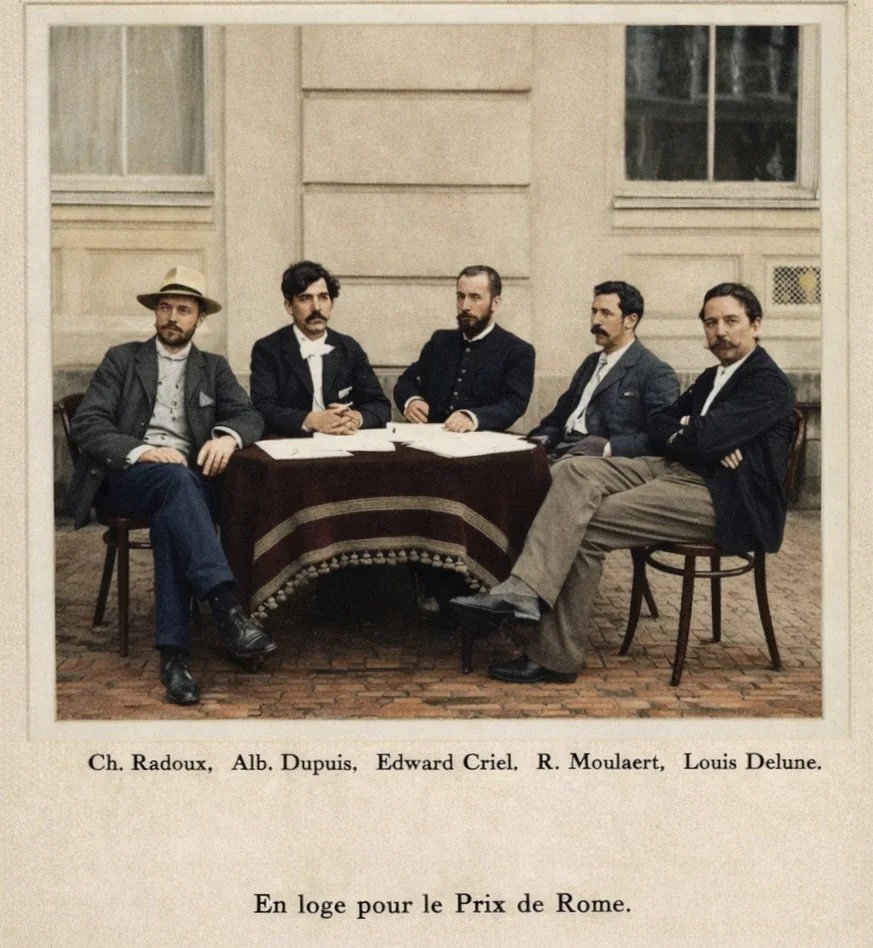
Let us also mention a concert given on August 8, 1898, in the salons of Princess de Polignac in Paris, where he performed on the organ Bach’s Toccata, on the piano four hands with his master Vincent d’Indy, the Prélude de la Suite, and for orchestra, his composition; likewise an essay in lyrical drama entitled Ilda, whose first act was completed in 1898 and was never continued. This work was performed in Verviers with orchestra, soloists, and chorus during the same year. Here we are in 1899, and our young artist, feeling more and more master of his talent, returned to Belgium to face the competition known as the “Prix de Rome.” He was not yet twenty-three years old. In the preliminary test, he was ranked first for the composition of the fugue and the motet. In the final test, he found himself in the presence of older competitors; for some of them, having reached the age limit, this was their last chance of success. The imposed poem for the cantata, written by the Flemish poet Verhulst, was entitled Cloches nuptiales, whose subject, developed in three parts, dealt with one of the great dramas of the sea. At the announcement of the results, Albert Dupuis was one of the two winners: he obtained the second Prix de Rome, with congratulations from the jury. Given his young age, it seems that the jury would have taken this into account in its decision; it was a remarkable success. The future remained wide open to him.
-15
The city of Verviers prepared for its young and brilliant fellow citizen an enthusiastic reception, the memory of which still shines among the great events of the city. Processions, decorated streets, enormous crowds, speeches, and flowers gave to the young artist all the hopes that one places in his future. Charles Bordes, his professor, friend, and protector at the Schola, had come especially from Paris for the occasion. He delivered one of those eloquent speeches in which he showed how much Verviers had the right to be proud of the young Albert Dupuis. “It is with great interest,” he said, “that the Schola has followed his development, noted his progress, and believes in his future. The French school,” he added, “and our dear master Vincent d’Indy, while contributing to the development of Dupuis, have not only served Verviers and Belgium but the universal art. We know that your young citizen will hold a prominent place. Son of the old Walloon family, always beautiful, we must mutually assist one another, for if the North gives us strength and structure, we must add grace, proportion, and rhythm, which are the heritage of our southern and singing race. Dupuis has understood this well: that is why I believe in his talent.”
Vincent d’Indy, always very paternal and seeking constantly to temper the exaggerated opinion one might form of an artist from his first successes, wrote to him, among other things:
-16-
“Although prizes and distinctions in reality add nothing to talent and often even harm it, I wish to congratulate you… I regret that a voice ailment has prevented me from reaching this year the goal of your efforts, but I am certain that you will reach it next year, unless some unforeseen misfortune occurs. Take advantage of this year to work, for you must not hide from yourself that you still have many things to learn, and always let yourself be guided by your artistic instinct, without seeking to flatter the opinions of this one or that: that is the best advice I can give you.” Making use of the advice of his worthy master, Albert Dupuis prepared to return to Paris, but his financial resources had become insufficient and prevented him from leaving. It was then that Charles Bordes, who had for several months been striving to overcome these difficulties, succeeded in appointing him choirmaster for the performance of the Oratorios of Saint-Eustache under the direction of Harcourt. This position was remunerated at one hundred francs per month, a not insignificant sum for the time, which nevertheless allowed him, while keeping other hopes in reserve, to resume the path toward his beloved Schola. Later, during the Paris Exposition, he assisted Charles Bordes in directing the singers of Saint-Gervais at the Chapel of the Métiers, specially erected for this famous choir in the Old Paris section. Thus he found himself once again in Paris (November 1899).
-17-
For his return to the Schola, a small intimate celebration had been organized for the young laureate of the Prix de Rome: the cantata Les Cloches nuptiales, accompanied on the piano four hands by Vincent d’Indy and the composer, was performed by the choirs of the Schola and various artists. At the same evening, one also heard the finest pages of Fervaal by Vincent d’Indy, interpreted by Jeanne Raunay, the creator of the work, as well as various organ pieces performed by the famous organist Guilmant. These were, moreover, the last months of study that he would spend at the famous institution created by Vincent d’Indy. In September 1900, Albert Dupuis, appointed Maître de Chapelle at the Basilica of Saint-Quentin, left the Schola Cantorum definitively and went to settle in the old city of Saint-Quentin.
-18-
His short stay there was marked by a fine artistic activity. He introduced the Maîtrise to the beauty of the works of Palestrina, Roland de Lassus, etc. On the occasion of a famous pilgrimage, he had the Messe au Sacre by Cherubini and the Tablettes de Saint-Quentin performed, and on this occasion he expressed himself in these terms: “The cult of sacred art is, without ceasing, an intelligent impulse to revive in our old church the beautiful traditions of the past. It is an honor for it, for us, and for those who were the true authors of this revival.” It was also at this time that he began the composition of his first lyrical drama: Jean Michel, the first two acts of which were written at Saint-Quentin. But soon he felt too confined in this small provincial town, where his bohemian nature could not adapt. The air, very quickly, became unbreathable for him, and one day, in one of those impulsive outbursts familiar to his character, he suddenly left—without great reverence, moreover—Saint-Quentin and his Maîtrise. Having sold his furniture in the greatest secrecy and taken leave of his landlord, without informing the Archpriest of the Basilica, who would have opposed his departure, he took the train for Paris, and Saint-Quentin, where he had just spent eight months, never saw him again.
-20-
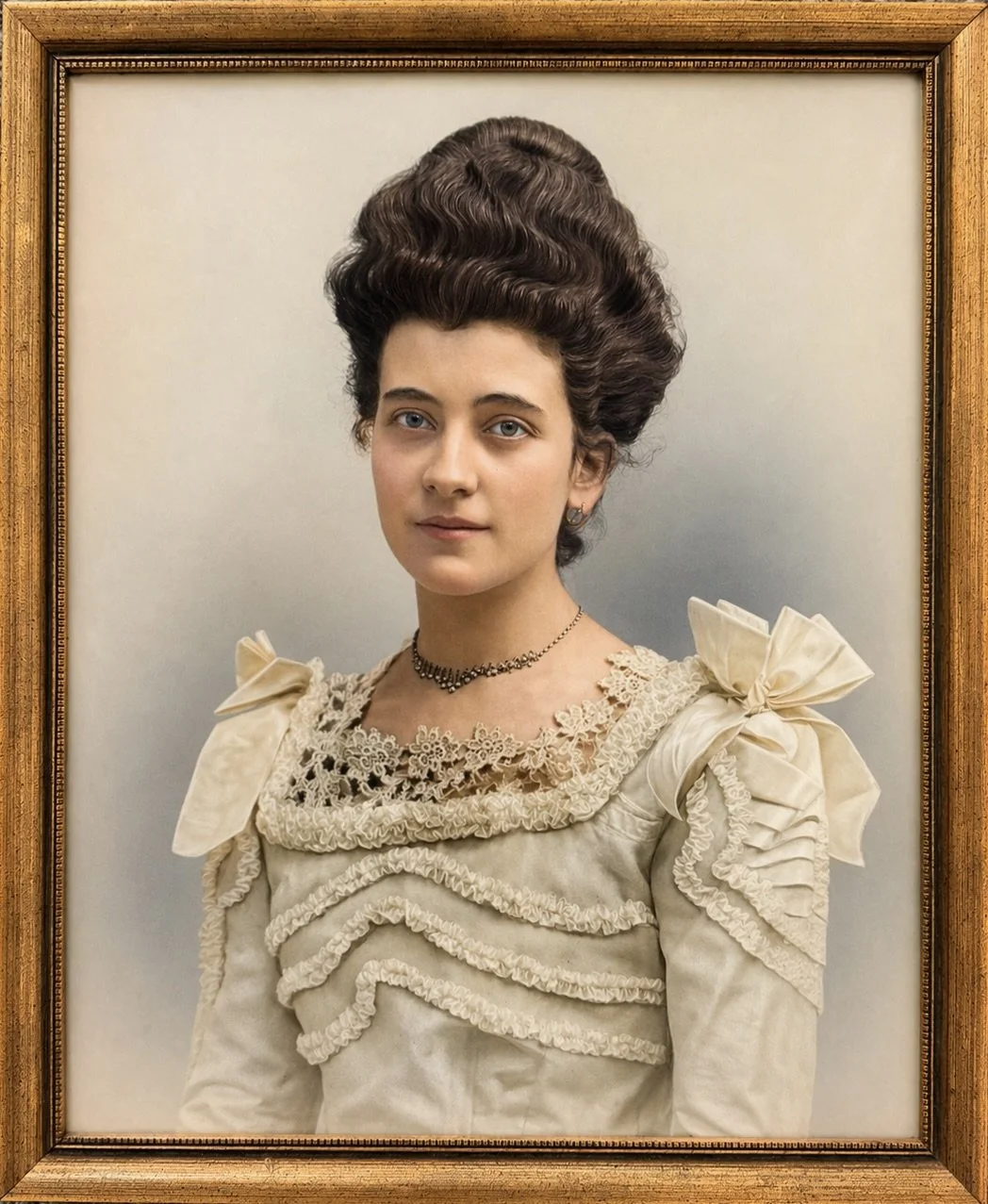
For a week, he breathed deeply the great air of Paris, whose nostalgia had not been overcome, and then, reassured, he returned to his native town of Verviers, where his career was now to be established. In the meantime, he had married, on November 28, 1900, Mademoiselle Maria Housman of Verviers, who, on numerous occasions, both at the Palais des Académies and in several concerts, would later defend the vocal works of her husband. Two days before this marriage had taken place at the Palais des Académies in Brussels, the official performance of the cantata Les Cloches Nuptiales. It was a great success, where a distinguished audience spared no applause for the young composer. The Prince and Princess Albert of Belgium, who were present, congratulated him warmly. Returning to Verviers, Albert Dupuis actively continued his work of composition, which was frequently interrupted by concerts of his works.
-21-
It was at this time (1900–1901) that he wrote his Fantaisie Rhapsodique in three parts for violin and orchestra. This work, dedicated to Eugène Ysaÿe, was performed for the first time at a prize-giving concert of the Conservatory of Verviers. Later, it was performed almost everywhere with great success, and Mischa Elman played it throughout America. Among numerous American newspapers reporting on the impression produced by this work. In 1901 there occurred in the career of Albert Dupuis a tragicomic episode, whose somewhat ridiculous incidents brought honor to the young composer and shed a clear light on the value of the judgment of competition juries. In August 1901, Albert Dupuis decided to present himself again for the Prix de Rome. Let us recall that in the previous competition he had been ranked first in the preliminary test and that in the final test he had obtained the second prize with congratulations from the jury.
-22-
As required by the regulations, he submitted again to the preliminary test and, to general astonishment, was ranked seventh. Now, only the first six were admitted to the final test. Albert Dupuis, after all his successes in the previous competition, suddenly no longer had enough merit to be admitted to compete. What was the value of the work produced by the composer? We are not in a position to judge it, but the future will undoubtedly one day shed light on this point. Were there, as in all human affairs, particular considerations that influenced the judgment of the jurors? The main interest might perhaps be to answer this question, which, for our part, we must leave in the shadows. Be that as it may, the jurors themselves were the first to be alarmed and to feel affected by their own decision, and they immediately addressed the Minister—what admirable presence of mind!—with a request tending to allow exceptionally the admission of a seventh competitor. In view of this ministerial decision, it was decided that Albert Dupuis would join his competitors and would in turn enter the lodge on August 15, two days after the others. The imposed work was a cantata for soloists, choir, and orchestra, on a text by Jules Sauvenière: Œdipe à Colone, taken from the tragedy of Sophocles.
-23-
From August 27, although the deadline did not expire until September 13, Albert Dupuis had already completed his score and had begun copying it, when a clerk from the Ministry came to notify him of its rejection. This news caused a sensation, both outside and among the competitors, and one of them, with great generosity, even offered to give up his place to Albert Dupuis. But all was in vain: he had to submit and withdraw. The press seized upon the incident and launched a campaign that made all the newspapers echo his cause, and which, shortly afterward, had the desired effect, for the Government modified the competition regulations and decided that henceforth a laureate who had placed second in a previous competition would no longer have to undergo the preliminary examination. Amid these controversies, the newspaper La Meuse, during this press campaign, had published the entire finale of the cantata, and the cantata itself, Œdipe à Colone, was performed in full on April 5, 1902, by the Royal Society “L’Emulation” of Verviers. Le Petit Bleu wrote on this subject: “It is a work of reparation that ‘L’Emulation’ has undertaken, and yesterday’s superb performance has completely avenged the young composer, who was the object of a long ovation.” But at this moment, Albert Dupuis had finished his first great lyrical drama: Jean Michel.
-24-
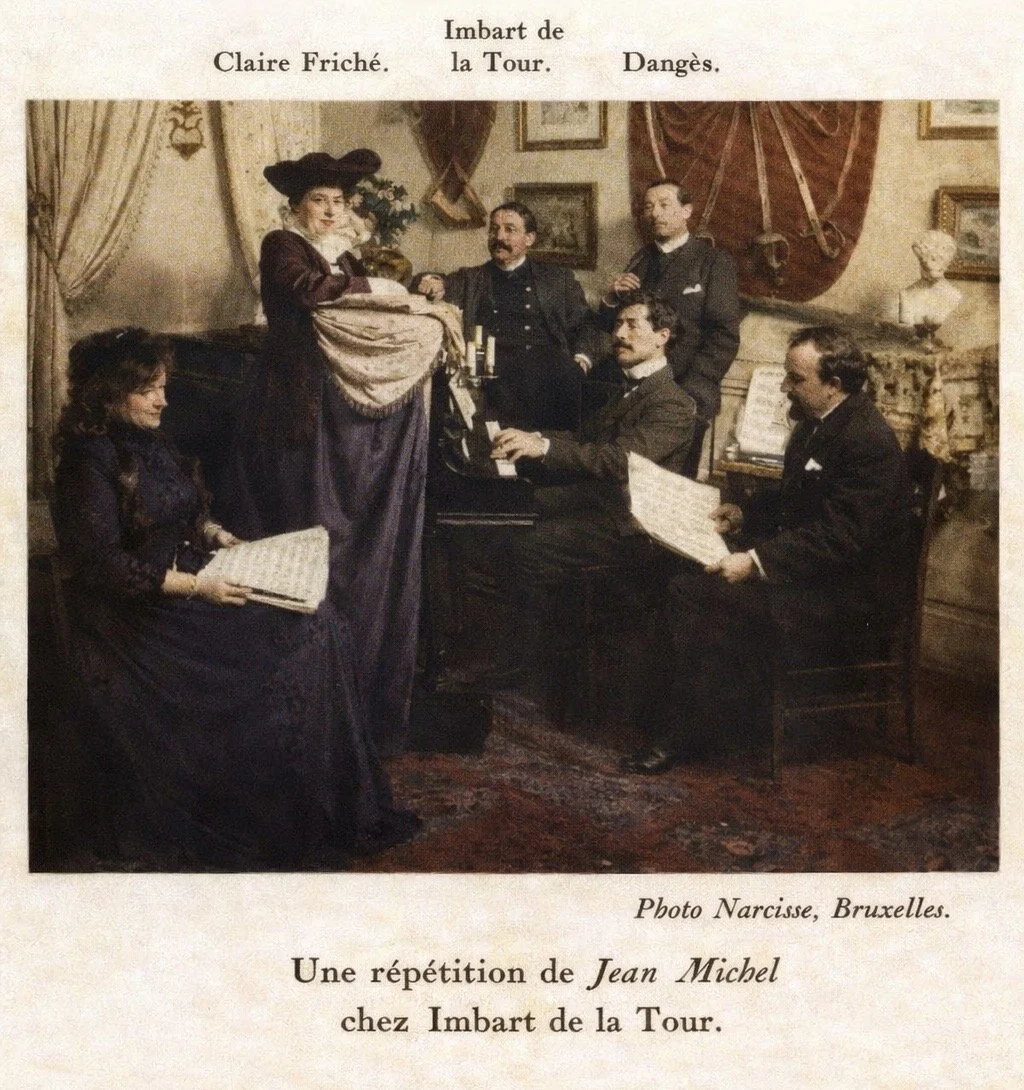
Presented to Messrs. Kufferath and Guidé, directors of La Monnaie, they agreed to hear it and, after an audition at Mr. Guidé’s house in the presence of several artists, immediately decided to create it in 1903 on the main lyrical stage of Belgium. Jean Michel was premiered at La Monnaie on March 5, 1903. Its principal performers were Madame Claire Friché and Messrs. Imbart de la Tour and Dangès.
-25-
Soon, extracts from this work were performed almost everywhere, and Eugène Ysaÿe, who had presented them at the Ysaÿe Concerts in Brussels, later made them known in America. I note in particular performances at the “Concerts Sechiari” in Paris and the “Concerts Classiques” of Monte-Carlo and Cannes, etc. On August 2, 1903, an Albert Dupuis festival was organized in Spa, where excerpts from Jean Michel and the cantata Œdipe à Colone were performed. A few days later, Albert Dupuis, without holding any resentment, submitted himself once again to the jury of the Prix de Rome competition. The imposed subject was La Chanson d’Halewyn, a poem drawn from an old Flemish legend. The story of this competition is one of the simplest: the tragicomic episodes of the previous one did not recur, and the jury—“quantum mutatus ab illo!”—unanimously awarded Albert Dupuis the First Prize with congratulations from the jury. Verviers, his native city, once again went to great expense and gave him a second triumphant reception.
-26-
His old master, Vincent d’Indy, whose friendship he had never ceased to cultivate and whose advice he deeply appreciated, congratulated him warmly and added: “There you are now with your foot firmly in the stirrup. That is perfect, and I hope you will take advantage of this favorable situation you have created for yourself in order to work hard and do good things.” Work hard! Do good things! That is indeed what Albert Dupuis was going to do and what he has always done. With a richness of inspiration and an ease of expression that have never been equaled in Belgium, he would successively, or even simultaneously, devote himself to the most diverse genres, while nevertheless reserving the best of his efforts for the theatre, which always exercised a profound fascination over him. From then on, from this apparently inexhaustible source, compositions of the most varied kind would flow in a continuous stream—bearing witness each time to ever greater freshness of inspiration in line and color, to the power and originality of the orchestration in development, of this astonishing artist. Operas, symphonic works, compositions for piano, violin, voice, etc., would follow one another with regularity, with a fecundity that would provoke the loudest cries from detractors, who would shed crocodile tears over this supposed waste of talent in works produced too quickly. “Try first to do as much,” Dupuis might have replied to them, but he did not concern himself with it, confident in the judgment of posterity, and he continued tirelessly his incessantly fruitful work. Dogs bark, the caravan passes.
-28-
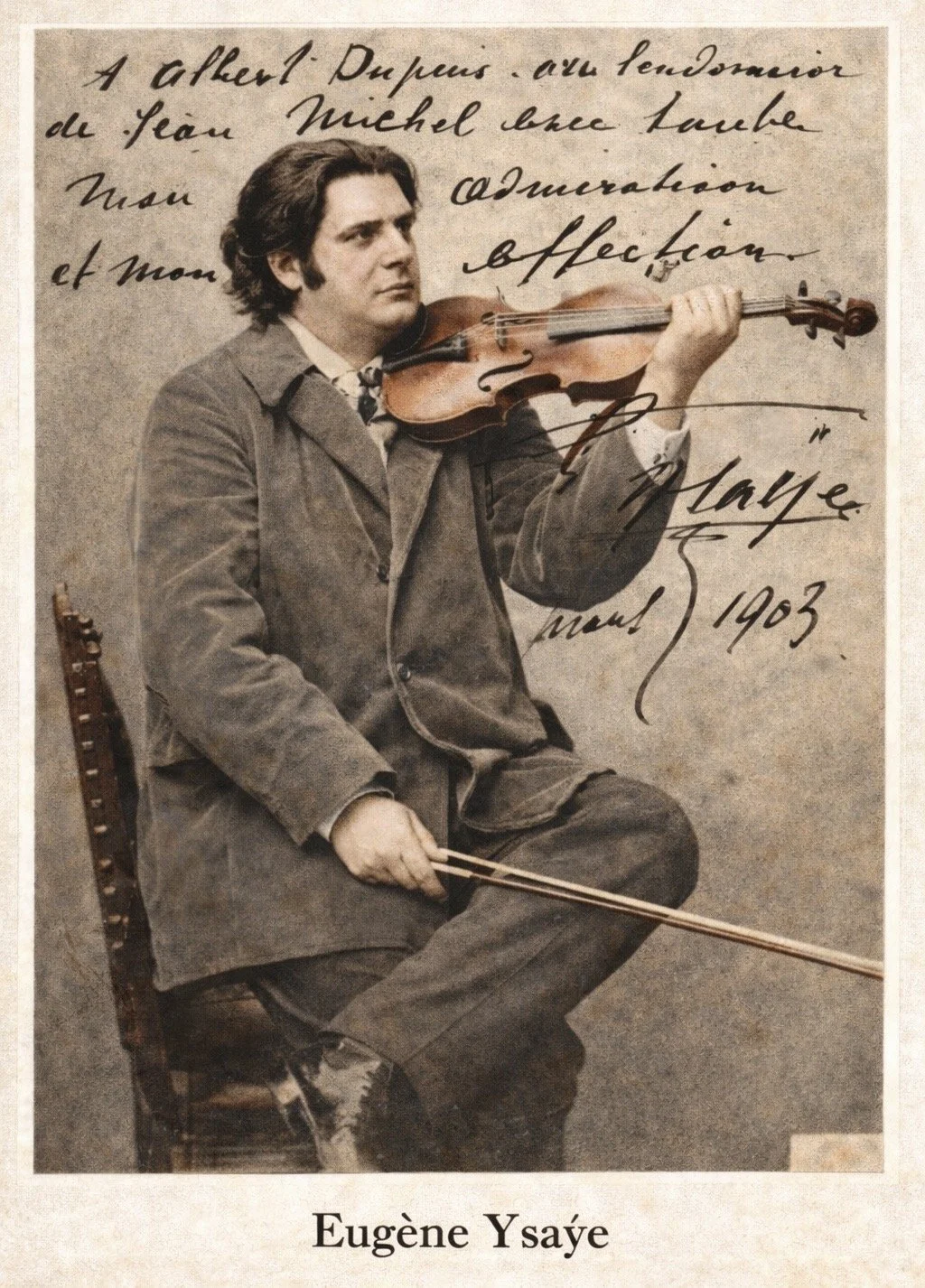
The great violinist Eugène Ysaÿe, who throughout his career never ceased to support Albert Dupuis with the full weight of his sincere friendship and his great talent, wrote him a letter which seems interesting to publish in full, because it shows in its true light the spontaneous, warm, and picturesque character of the eminent and ever regretted deceased. Here it is: “Dear Triumphant One! I have failed in all my duties. I should have tried to see you, to run after you, to embrace you, to congratulate you, to give you all the pleasure that your successes have caused me, but… I have no address here, and in Verviers you are, I know, in laurels, in monstrous tarts and under the flowers of rhetoric of the gentlemen aldermen and fine speakers. Forgive me then, my friend, and if the best of your friends is perhaps the last to come and congratulate you, you see what an unfortunate fate pursues him, good intentions, the best intentions. Well then, dear Dupuis, here you are officially crowned; your talent is ‘patented,’ the ‘Medics’ have stamped you with the blow of their palace; the Ancients have said to you: ‘Tu Marcellus eris’; and they have added that all the happiness, all the glories will be realized for you. Walk without running, compose, eat cake and micot, and above all do not forget that I have inscribed in my musical record of this winter a symphonic poem by Albert Dupuis, which is not yet composed but which must be! I have it there… I will not be present at the hearing of the cantata… You should give me a small compensation and come to play me the fruit of your twenty-one days, between a piece of cold veal and a pipe… Shall we meet next week? To you, dear friend, bravo and bravo! I embrace you warmly. October 6, 1903. E. Ysaÿe.”
-29-
On Monday, November 25, 1903, at the Palais des Académies, the performance took place, with soloists, chorus, and orchestra, of the prize-winning cantata: La Chanson d’Halewyn.
-30-
This Prix de Rome, which had already brought so many emotions to Albert Dupuis, still reserved for him a final ordeal, of which the oddity deserves to be passed on to posterity. A rather substantial sum of money, intended to allow the laureate a stay abroad, was attached to this prize. But a regulation, in which the eternal subtlety of the Administration showed itself, subordinated the granting of this sum to a final literary examination, passed before a special jury of… composers! One might think one is dreaming when reading this, but it is perfectly authentic. Albert Dupuis therefore had to appear before the said judges, who, after asking him a number of questions worthy of a primary school examination, declared themselves satisfied. It was scarcely lacking that he be asked to recite the fable of the Crow and the Fox.
-31-
But the incident had amused certain circles close to the young laureate, and a few days later the humorous Georges Garnir published in Le Petit Bleu—a widely read newspaper of the time—under the pseudonym “Curtio,” the witty article reproduced below:
FANCIFUL REMARKS
THE EXAMINATION OF MR. A. DUPUIS
Mr. Albert Dupuis, Prix de Rome, brilliantly passed yesterday, before the official jury—composed of Messrs. Huberti, Mathieu, Léon Dubois, Block, and Sylvain Dupuis—the examination in literature and history which the regulations require for the payment of the prize awarded to him for his musical composition. The jury entered at half past two and took their places before the green cloth. Mr. Huberti, president of the jury, addressed a brief preliminary speech to the recipient: “A regulation, whose eminent ‘Kestergatism’ may be appreciated in this official assembly by my colleagues and myself, obliges us, Mr. Albert Dupuis, to assure ourselves of your intellectual culture. Please excuse the naive nature of our examiners’ questions. Do not be alarmed if, during the interrogation, we ask you questions to which it will be easy to answer.” Mr. Block (struck by a bright idea): “To simplify the procedure, the candidate could question us himself. That would still be an examination!” All the examiners: “Perfect! Bravo! That’s it!” Mr. A. Dupuis: “Gentlemen, I thank you. If you permit, I will begin with Mr. Sylvain Dupuis. Would you, sir, the first conductor, tell me who invented gunpowder?”
-32-
Mr. S. Dupuis: “That’s you!” Mr. A. Dupuis: “I am grateful for your intention, but your answer is unfortunately not exact. The invention of gunpowder is lost in the night of time: we are assured that Berthold Schwarz, the Japanese, the king of Luang-Bing-Pang—no, I do not wish to tire you with my erudition. I prefer to ask another question: At what time was the discovery of the thread used to cut butter made?” Mr. S. Dupuis: “At Mr. Kestergat’s birth!” Mr. A. Dupuis: “And that of the discovery of water?” Mr. S. Dupuis: “To Demosthenes.” Mr. A. Dupuis: “Very good. I move on to Mr. Block. Universal history: What, Mr. Block, was the first man executed at the Stock Exchange?” Mr. Block: “Abélard.” Mr. A. Dupuis: “I congratulate you. In your turn, Mr. Huberti. I am going to ask you a question which, while relating to natural history, also touches upon music. What difference is there between a crocodile and a cello?” Mr. Huberti: “It is that a great deal of patience is required to learn to play the cello, but one could never learn to play a crocodile.” Mr. A. Dupuis: “Perfect! And you, Mr. Dubois, would you tell me the difference between a flea and an elephant?” “I will have you notice that the question concerns both the Congo and insecticides.” Mr. Dubois (without hesitation): “It is that an elephant can have fleas, but a flea can never have elephants.” Mr. A. Dupuis: “Wonderful. One last question for contemporary history. Mr. Mathieu, would you explain to us the secret negotiations between Prussia and Schleswig-Holstein during the war of 1866?” Mr. Mathieu (very embarrassed): “Mr. Dupuis, those negotiations are secret, and I believe that the most elementary courtesy obliges me not to reveal them here.”
-33-
Mr. A. Dupuis: “This delicacy does you honor. The final test to which I am about to have the honor of submitting you, gentlemen, will be collective. Would you kindly go into the adjoining room, where you will find everything necessary to write, and compose a short letter in which you will ask a theatre director to receive an opera that you have just finished? (The examiners take note.) I beg you, gentlemen, do not fail me in this; I would be very sorry.” Form yourselves into a group of five; write your letter together. It is only fair that I do not console myself for not seeing you perspire on the occasion of this composition. (The five examiners leave the room and withdraw into the adjoining chamber. After five minutes, they return with a document which Mr. Huberti, president, reads, his right hand placed on his heart.) Mr. Huberti: “Here it is: ‘Sir, I have the honor of sending you under this cover an opera in seven acts, which I beg you kindly to have performed on your stage. Please accept, etc…’” Mr. A. Dupuis: “Bravo! I give you the maximum for this question. As a whole, I am going to withdraw and deliberate.” (He withdraws. After half an hour of deliberation, he returns. The examiners, anxious, very pale, very moved, await the reading of the sentence.) Mr. A. Dupuis: “After mature reflection, I declare that I award the jury a first prize in courtesy as well as a diploma, noting that it has shown sufficient tact to overcome the difficulties that ‘Kestergatism’ would like to impose on laureates by irrelevant demands. I congratulate the jury for having understood that it would be grotesque, lamentable, and offensive to require from a musician that he possess the special knowledge of a doctor in philosophy and letters. I invite the Government—no less!—since, thanks to the attitude of the jury, I am rid of this formality, to provide, from now on, in the establishment of the regulations of these competitions, a feeling more in keeping with its dignity and the deference owed to artists.” (The jury applauds frantically.) For certified stenographic record: CURTIO.
-34-
Let no one imagine that this is merely a charming humorous fantasy. Most of the questions were indeed asked. The drafting requested was indeed the letter in question, and it is true that Albert Dupuis amused himself by letting the examiners speak at great length before giving them a letter of three lines. And as for the question of gunpowder, it was Mr. S. D… who assumed the intelligent paternity of it. Arriving—because of a train delay—at the moment when the examination was over, and the examiners were about to announce the satisfactory result, S. D…, who probably did not wish to lose the fruit of long meditations, insisted and obtained permission to ask one additional question. And it was then that, amid general hilarity and to the dismay of a university professor, he pronounced: “Could you tell me, Mr. Dupuis, who invented gunpowder?”
-35-
Later, very irritated by the publication of the article in Le Petit Bleu, for which he held the recipient responsible, although he could do nothing about it, he long kept a stubborn resentment toward him. And he had more than one occasion to make him feel it. Small causes, great effects: once again one of those small vanities, involuntarily wounded, whose accumulation ends up creating around a man an atmosphere of hostility, often heavy with consequences.
Albert Dupuis, as we have said, is not one of those who rest on their laurels. In January 1904, he completed a Nocturne for four mixed voices with orchestral accompaniment. This work was sung almost everywhere, notably at a concert for the Vieuxtemps Centenary under the direction of Eugène Ysaÿe, and at the popular concerts of the Théâtre de la Monnaie in Brussels. That same year, he wrote Martille, a lyrical drama in two acts, commissioned by Messrs. Kufferath and Guidé of La Monnaie, on a libretto imposed and written by Mr. Ed. Cattier, art critic in Brussels. In October 1904, he completed his First Symphony in four movements. This work had been written to commemorate the anniversary of Belgian Independence, but, because of various intrigues, it was not performed on that occasion.
-36-
It was Eugène Ysaÿe who, in March 1905, had it performed for the first time at one of his concerts (Ysaÿe Concerts). It gave rise to very diverse reactions, which reminded Albert Dupuis of the “setbacks” inseparable from success, as his master Vincent d’Indy had pointed out to him some years earlier. While Ysaÿe and his musicians, standing before the orchestra, acclaimed the young composer—supported by part of the audience—another part of the public, through cries and whistles, expressed a violent disapproval. After the concert, Albert Dupuis, deeply troubled, expressed to Eugène Ysaÿe his keen regrets and disappointment at this reaction, but the famous violinist immediately replied with humor: “Be happy, my dear Dupuis… you have had demonstrations, even whistles… be happy: not everyone can say as much.” It is fair to say that this disapproval did not concern so much the symphonic construction of the work as its guiding idea, for some accused it of lacking respect for the Belgian national anthem. And then Albert Dupuis was beginning to take up perhaps too much space on the musical scene: something rarely forgiven to artists during their lifetime. This work also offered the particularity that, in its finale, the composer introduced a second orchestra composed of trumpets, trombones, and tubas. It was later performed again, under the direction of the composer, at a concert of his works in Boulogne-sur-Mer, as well as at a concert of the Conservatory in Verviers.
-37-
In 1904 as well, he wrote the first two parts of his First Sonata for violin and piano. Martille, a lyrical drama in two acts, was premiered at the Théâtre Royal de la Monnaie in Brussels on March 3, 1905. Its success was very lively, and the work was repeated several times.
The characteristic of Albert Dupuis, we have said, is that he never rests: scarcely is one work completed than his creative talent is already concentrated on a new one. To this continuous work and almost mechanical regularity is undoubtedly due the extraordinary fecundity that some are tempted to reproach him for. Those who work only in bursts cannot imagine that one can produce regular work, continuously and tirelessly, throughout an entire lifetime.
-38-
After Martille, he planned to write, in collaboration with Maurice Léna for the libretto, a lyrical drama based on Andersen’s tale The Little Mermaid. The collaborators agreed, established the general plan of the work, and, in order to avoid any possible duplication, published a notice in the Paris newspapers announcing their project. Then suddenly, from all sides at once, Little Mermaids already in preparation emerged, claiming priority: Princess de Polignac announced in L’Écho de Paris that her Little Mermaid—of which Gautier-Villars shared authorship—would soon appear at Nice; Léon Moreau, in collaboration with Mr. Carré, protested on behalf of his Little Mermaid; finally, Fernand Leborne in turn entered the fray with a Little Mermaid disguised as Hedda, while, beyond the borders, an Italian composer also asserted his priority rights. Faced with this proliferation of “Sirens,” A. Dupuis and Mr. Léna, rightly alarmed, quickly abandoned their project, and our composer went to seek elsewhere a subject less exploited and more discreet.
At the end of 1905, Albert Dupuis was appointed opera conductor at the Grand Theatre of Ghent, and he was thus installed for a season in the great Flemish city. The newspapers of the time were full of praise for the initiative and intelligent direction of the young conductor. We owe this magnificent transformation above all to the new arrival, who took firm and secure control of the direction of our orchestra…
-40-
But the absorbing duties of the conductor scarcely allowed the composer to devote himself to his favorite work, and it was only with difficulty that he was able, during this period, to compose a few new melodies. Thus, the season ended, he did not seek renewal of his contract and returned to Verviers, not without having attended, however, at the Grand Theatre of Ghent, a concert of his works, where, notably, the cantata La Chanson d’Halewyn was performed, with the participation of the choral society “Les Mélomanes” and soloists Madame Feltesse and Mr. Girod. In April 1907, a concert took place at the Grand Theatre of Verviers devoted to the performance of his works. Eugène Ysaÿe attended this local consecration of Albert Dupuis’s talent, and did not cease, by every means, to encourage and protect him. Among other works, the Fantaisie Rhapsodique, which Albert Dupuis had dedicated to the famous virtuoso of the bow, was performed. And finally, shortly afterward, in October 1907, the direction of the Conservatory of Verviers having become vacant following the unexpected departure of Mr. Kefer, Albert Dupuis was appointed by the municipal council to oversee the destiny of the local academy of music.
-41-
Here he is, then, barely thirty years old, placed at the head of a major institution of musical education. Although Verviers is only a provincial town, it nevertheless forms, with its surrounding suburbs, an agglomeration of nearly one hundred thousand inhabitants. Moreover, together with Liège, it belongs to that region of Belgium where the love of music has reached the highest degree and which, for more than a century, has been the cradle of a host of artists of often worldwide renown. It is this Wallonia of Liège and Verviers that can take pride in the names of Grétry, Vieuxtemps, César Franck, G. Lekeu, Eugène Ysaÿe, to which may be added more recent ones such as Ed. Deru, Jacques Gaillard, Thomson, Vreuls, Herman, Jongen, etc. As we see, Albert Dupuis belongs to a great lineage of Walloon composers and virtuosi, and among them, posterity will no doubt place his name among the best. But at the moment when he accepted this directorial position, which was to fix his career definitively in Verviers, it was not without interest to ask whether fate, in orienting him toward this path apparently full of promise, was not in fact placing him in an environment that would later prove unfavorable to the full development of his talent and to the success of his future.
The abundant gifts of inspiration and the creative spark that characterize the true composer do not necessarily go hand in hand with the qualities that make good administrators. To impose one’s authority on an educational institution already grouping at that time nearly a thousand students—a number that would still increase—and on a very diverse teaching staff, having only limited and temporary obligations, is not a task within everyone’s reach.
-42-
Taking into account also the very particular character of the artistic milieu, a population difficult to govern and poisoned by vanity, envy, and a thousand petty professional jealousies, one can better imagine the difficulties of such a task, falling upon a man scarcely out of youth. Until then, Albert Dupuis had known only friends. From now on, he would have to bear the growing weight of all the hostilities that his decisions as director would inevitably provoke, as much among professors, in their perpetual rivalries over the slightest vacant position, as among students and their families, too ready to make the director responsible for their disappointments. Certainly, it was a difficult task, made even more complex by the fact that the young director found among his subordinates several of his former teachers. To succeed, it required, here more than elsewhere, “an iron hand in a velvet glove,” a dictator combined with a diplomat. Although Albert Dupuis, with his impulsive temperament, was not endowed by nature with all the gifts that in such circumstances would have been desirable, he nevertheless set to work with the greatest enthusiasm. And indeed, no one could fail to recognize that his administration was not without its successes from the point of view of the musical development of his institution. But this is not the place to dwell further on this point.
-43-
The interesting question is to know to what extent the functions of director may have harmed the composer’s career. In reality, one may be surprised that, in the midst of the constant and varied concerns entailed by these new duties, of which we have just tried to give some idea, Albert Dupuis at no moment slowed down his compositional work. The inexhaustible source continued to flow and, despite all sorts of difficulties, despite even disappointments, it continued to flow until the final day, without respite and without fatigue. From this point of view, there does not seem to be any harmful influence to record. But it is not the same, unfortunately, if one considers the immediate and palpable results of his productions, in other words the material success of his career and his artistic reputation in the world. Immobilized far from the capital of his own country and, even more so, far from the great artistic centers of Europe, he would henceforth devote himself to an incessant and most often fruitless struggle to achieve that passionate desire of every artist: to give his works a true life through public performance.
“How,” one might object, “no Belgian composer, as much as Albert Dupuis, was performed so often both in Belgium and abroad?” Granted, but through the abundance, the variety, and the originality of his conceptions, through the extraordinary mark of his talent, did he not deserve a hundred times more? This composer, who will soon have to his credit about ten operas and an enormous flowering of symphonic, instrumental, and choral works, can he be compared to so many of his contemporaries who, during their existence, struggled to produce with difficulty a few works, more or less successful?
-44-
“Can anything good come out of Nazareth?” The lamentable biblical saying remains eternally true, and throughout his career Albert Dupuis, director of a conservatory in a small and almost unknown town, would bear its weight. For his talent, Paris would have been necessary, or at least Brussels. The great city adds the value of its stamp of origin to everything it produces. On several occasions, the opportunity presented itself for him to escape toward broader horizons, but he no longer had the freedom of movement necessary: heavy family responsibilities commanded him not to cast his shadow too far, and until the end he remained in Verviers, surrounded by growing intrigues and by a provincial circle, where, certainly, admirers were not lacking, but where there was also no shortage of a cohort of obscure envious detractors. But are not all these petty things the inevitable price of talent?
Since here is Albert Dupuis definitively settled in Verviers, it will no longer be necessary to follow him step by step in his career.
-45-
It will be easier to outline in it a few major stages and, for each of them, to glance at a series of his compositions. Let us first consider the period which extends from his entry into the Conservatory until the beginning of the Great War in 1914. One notes that these six years are characterized above all by an abundant lyrical production: for it is during this short span of time that, in addition to more than a hundred works of the most diverse character, he wrote Fidelaine, La Grange Bretèche, La Passion, and that he adapted for the stage La Chanson d’Halewyn. For anyone who knows the tremendous labor that constitutes the composition and completion of a single opera—especially when all the additional work (full orchestral score, piano-vocal reduction, orchestral material and vocal parts) must, for material reasons, be done for the most part by the composer himself—this labor will appear a true tour de force. And one does not know what to admire most, whether the immense inspiration of the composer or the inconceivable courage it required, beyond all his professional and other work, to bring to completion, in so little time, such an almost superhuman task. Let us pause, with a few details, on each of these works.
FIDELAINE. On a libretto overflowing with intense poetry by Honoré Lejeune, but unfortunately lacking somewhat in dramatic action, Albert Dupuis composed, in 1908–1909, a lyrical drama in three acts.
-46-
This work was immediately submitted to the jury of the “Ostend Center of Art” Committee, which had organized a competition for lyrical works. It obtained first prize. It was premiered in 1910 at the Théâtre Royal of Liège and revived the following year. Fidelaine, an extremely original and distinguished composition, displayed harmonic tendencies that were unusual for the time and surprised an unprepared audience. Thus it was received with some mistrust by the majority, but with enthusiasm by the dilettantes.
-48-
This work, as far as we know, was never revived on other stages. In our opinion, it was ahead of its time, and perhaps one day, saturated by the excesses of action recorded in cinema, the public will return to the idealized emotions of music in the theatre that addresses itself more to the ear than to the eye; they will find in Fidelaine, which can be heard without fear, an exceptional work where emotion draws from the purest sources.
LA GRANDE BRETECHE (Editions Eschig). On a libretto drawn by Messrs. Paul Milliet and Jacques Dor from a short story by Balzac entitled La Grande Bretèche, Albert Dupuis wrote, in 1911–1912, a score that departs notably from the inspirations of Fidelaine and aims more to satisfy the public’s taste for melodic phrases. This work was premiered at the beginning of 1913 at the Grand Opera of Nice (direction Villefranck), with the participation of Mlle Ixo of La Scala in Milan, the tenor Razavet, and Mr. Lafont of the Opéra-Comique in the principal roles. Its success was very great. It was immediately published by the publisher Max Eschig in Paris under the title Le Château de la Grande Bretèche, which it would definitively retain and under which it was performed again the following winter, with great success, at the Grand Theatre of Verviers. This title later underwent a few variations and became successively: Pâques Fleuries (performances in The Hague) and Le Sacrifice (performances in Antwerp),
-49-
before finally returning to Balzac’s exact title: La Grande Bretèche, which it would never abandon again. It should also be noted that, in the meantime, the first act, performed more than once, underwent several modifications. The war then abruptly interrupted a career that seemed very promising, but from the armistice onward performances resumed regularly in the most diverse theatres of Belgium and France.
-50-
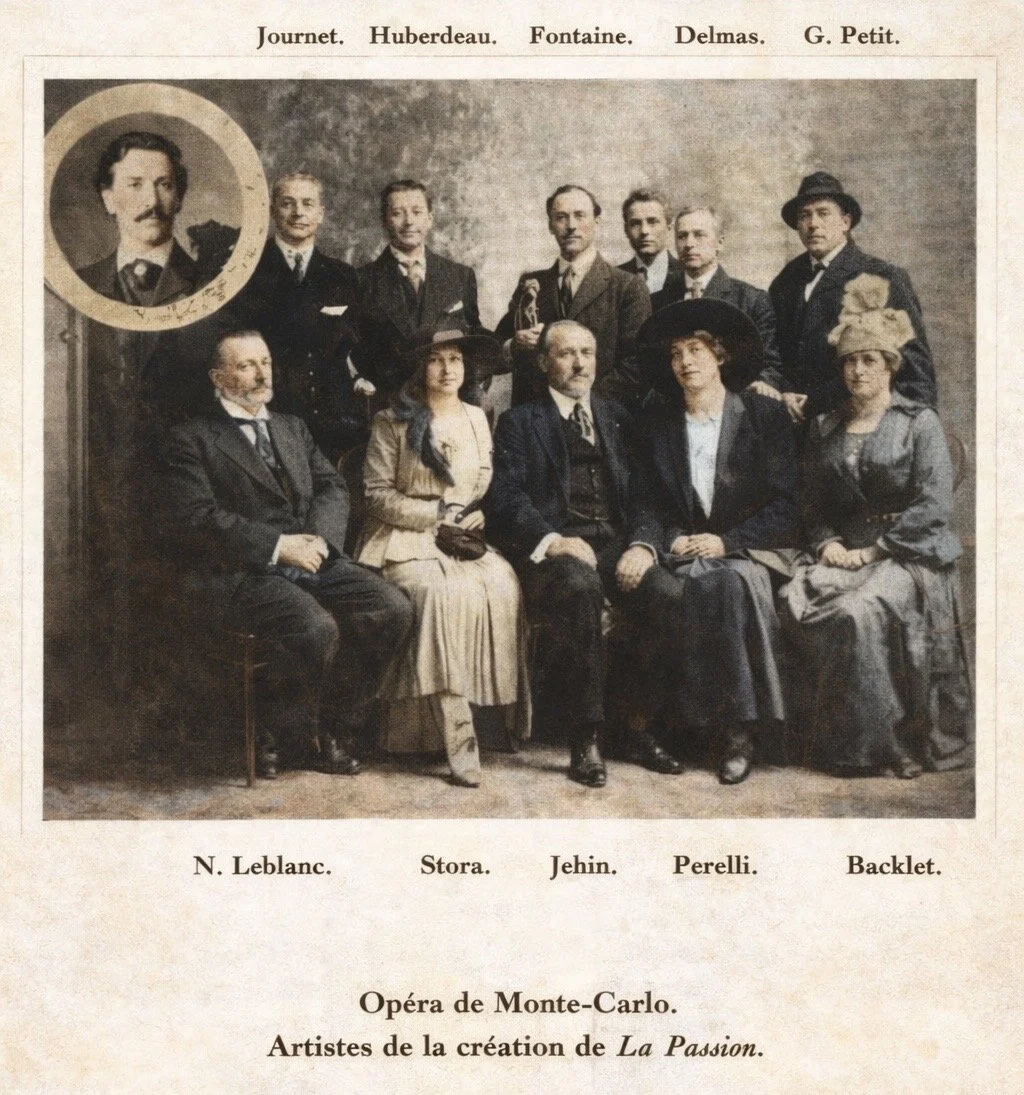
THE PASSION (Editions Choudens). In 1912, Albert Dupuis began the composition of this important work, in four acts and ten tableaux, the libretto of which was signed by Messrs. Jules Mery and P. de Choudens. He completed it at the beginning of 1914. It was premiered, during the war, on April 2, 1916, at the Grand Opera of Monte-Carlo, in a gala evening for the benefit of the French, Belgian, and Serbian Red Cross, in the presence of the Prince of Monaco, to whom the work was dedicated, and of the Ambassadors of Belgium and Serbia in Paris. Nothing had been neglected to ensure its success, and it was superbly defended, under the direction of Léon Jehin, by artists of the highest value: Messrs. Fontaine, Journet, Huberbeau, Delmas, Mesdames Perelli, Stora, and Barclay, all from the Paris Opera. The luminous sets of Mr. Frey and those painted especially by Mr. Visconti were magnificent. From the end of the war, La Passion began a career whose success never waned and which led it to most of the theatres of Belgium and France.
-52-
THE SONG OF HALEWYN (Editions Eschig). Albert Dupuis, in order to give life to the ideas that sprang endlessly from his creative inspiration, always carried out the composition of works of the most diverse kinds and in all genres at the same time. Thus, in 1912, having outlined the musical plan of La Passion and developed this work from the point of view of ideas and tonalities, he conceived the idea of staging his Prix de Rome cantata, La Chanson d’Halewyn, and continued both works until their completion. This method of work, which consists of seeking rest for the mind by simultaneously tackling works of different genres, always had his preference.
-54-
It is obviously not within everyone’s reach, since it requires, as a primary condition, an abundance of inspiration beyond the ordinary measure, but it explains in this privileged author both the gifts of his nature, the extraordinary fecundity of his production, and the means employed to achieve it. The premiere of La Chanson d’Halewyn took place at the Flemish Opera of Antwerp on December 6, 1913 (direction Fontaine). Judging by the praise of the press, this work made a strong impression on the public. But the war, once again, with all its devastation, came to oppose the further development of this opera, which has since not reappeared on stage.
-55-
We have just said that Albert Dupuis, who never rests in the continuity of his production, always carries out, alongside his compositional work, the most diverse activities. One will not be surprised, then, if during these six years (1908–1914), which saw the birth of four great operas whose success was immediately established, the composer also produced a very large number of other works, the enumeration of which would be too long here. Let us mention, among the most important: Méditation, for choirs and orchestra, on a poem by Émile Verhaeren; Impressions carnavalesques, an orchestral work in four parts; Trio No. 1 for violin, cello, and piano; Lucas et Lucette, a symphonic work in several parts (Concerts Sechiari in Paris); Hermann et Dorothée, a symphonic overture after a poem by Goethe. This latter work, presented at the competition for symphonic works organized by the New Concerts of Antwerp, obtained first prize and was subsequently performed with great success, notably in Antwerp, at the Pasdeloup Concerts in Paris, and at the Cincinnati Symphony Concerts (conducted by Eugène Ysaÿe), etc. If one adds that, during this time, Albert Dupuis was still occupied with restoring the Popular Concerts of the Conservatory of Verviers, where he organized each year several major concerts, and that, in addition to his administrative duties and his teaching, he still found the means to write and publish an excellent little manual of musicology: Le Petit Musicologue, used in numerous Belgian institutions of musical education, and for which Massenet—whom Albert Dupuis sometimes met in Paris, in his legendary residence on Rue de Vaugirard—wrote the preface, one may form some idea of the formidable labor carried out joyfully by the composer from Verviers.
-56-
Here comes the war. For Albert Dupuis and his hopes, it was a disaster. Several major works, which had just seen the light of day and were beginning to take the path of success, were halted in their development and paralyzed; all communications were cut with collaborators, publishers, and theatre directors; theatres were closed: all musical life was suspended and reduced thereafter to the small center where he found himself confined. That is what the great catastrophe brought him. However, after the first months, when, in the general anxiety, all eyes were fixed on the battlefields, he gradually recovered himself, and despite the most unfavorable conditions, where concern for material matters occupied the greater part of attention, he managed to resume, though with difficulty, his compositional work and to take part, near or far, in a few performances of his works. But this did not happen without numerous setbacks and incidents.
-57-
In 1915, the French Opera of The Hague decided to stage La Grande Bretèche (as we have said, the work was performed there under the title Pâques Fleuries). Albert Dupuis, whose presence was deemed necessary there, obtained from the City Administration the leave required and, managing to cross the border in disguise, went to The Hague to direct the rehearsals and the staging of his work. But difficulties arose and matters dragged on: the first performance was repeatedly postponed. His leave expired, and the City of Verviers sent him increasingly pressing summons, even accompanied by threats, to return to his post. He hesitated. What should he do? In the end, he chose the lesser evil and returned to occupied Belgium. Had he remained, it is very likely that the rest of his career would have been transformed to his greatest advantage. A little later, in 1916, as we have said, the premiere of his great lyrical work La Passion took place in Monte-Carlo. This opera had been published by Choudens in Paris, so one could obtain the vocal parts there without difficulty, but the orchestral material had remained with the composer in Verviers. The latter could find no way to have it transported to Monte-Carlo: such material, as extensive as that of La Passion, does not pass unnoticed, and the borders were practically impassable. What was to be done? Would he have to helplessly witness the failure of this long-awaited premiere?
-58-
From Monte-Carlo, by indirect routes, urgent appeals were made for the dispatch of this material. There were only fifteen days left before the announced premiere. Poor Dupuis struggled, searching everywhere for a possible solution. Finally he succeeded: he learned that an industrialist from Verviers, Mr. Houget, was preparing, with authorization from the German military authorities, to send machinery to Zwolle, in Holland. Mr. Houget, with the greatest kindness, agreed to conceal among them the crate containing the orchestral material. Everything went well: the crate crossed the border without difficulty, and the representative in Holland of the Society of Authors, who had been warned, hastened to take possession of it and embarked urgently on the first boat leaving for England, from where he would go to Monte-Carlo. But English customs kept watch. A customs officer, opening the crate, discovered, to the astonished eyes of the unfortunate traveler, that it contained, instead of musical material, only civilian clothing. One more spy, without a doubt. Under good escort, the poor man was sent immediately to prison. He nevertheless obtained authorization to send a telegram to Holland, where the misunderstanding was explained: by mistake, a second crate containing clothes that Mr. Houget intended for his son at the Belgian front had been sent.
-60-
The right crate was fortunately still there: a commissioner took charge of it and finally arrived in Monte-Carlo, four days before the first performance. But the alarm had been great. In Belgium, where communications were almost reduced to nothing, a few theatres, little by little and intermittently, had opened their doors, but for Albert Dupuis, only those of Verviers and Liège were accessible and gave him the opportunity to perform, in fragments or in entirety, some of his works. Thus, in June 1916, Messrs. Maréchal and Delvoye, of the Opéra-Comique, decided to stage La Grande Bretèche at the Royal Theatre of Liège. Here again new difficulties arose: most of the musical material, as well as the scores, were with the publisher Eschig in Paris. Naturally it was impossible to obtain them. As always when it was a question of performing one of his works, Albert Dupuis set to work again and reconstructed, as best he could, everything that was missing. Finally, everything was ready: the preparation was excellent, the cast magnificent, the orchestra first-rate, and the curtain was to rise before a full house. But Albert Dupuis, continuing to be dogged by misfortune, saw the performance disturbed by one of those incidents that mark the life of the theatre. In the fourth act of this work, the heroine, whose supposed lover has been immured by a jealous husband, cries out her despair before the freshly walled-up door, represented in this case by a simple frame covered with canvas, fixed more or less lightly between the uprights.
-61-
Behind this door, an idle stagehand, glued to the gaps, watched the moving scene. Behind him passed a stage assistant who, in the darkness of the wings, bumped into him somewhat violently—and crash! Before the despairing heroine, who invoked all the powers of heaven and hell to return her lover and destroy this cursed door, it suddenly collapsed, and a stagehand in a blue blouse rolled at her feet, shouting a formidable “Nom de D…,” which echoed up to the gallery. Horror, stupefaction of the audience, then an explosion of laughter; cries and calls from the stage manager: “Curtain!” The act had to be restarted.
At the moment when war was declared, Albert Dupuis had just set to music several poems by Francis Jammes and, very impressed by the gentle poetry that emerged from a small intimate drama in several short tableaux by this poet, entitled The Poet and His Wife, he had adopted it as the libretto of an opera and had already begun the work of composition. Recovering from the first emotions of the terrible upheaval, he resumed the interrupted labor in 1915, brought it back to the workbench, reworked it, and completed it definitively in 1916. This work has not yet seen the light of day. Meanwhile, he had written a small lyrical drama in two acts, entitled La Délivrance, which he intended for soldiers at the front, with the aim of stimulating their courage and their hopes.
-62-
He had begun copying the score onto onion-skin paper in order to be able to conceal it more easily when crossing the border, when, after numerous efforts, he realized the impossibility of his plan and was forced to give it up. However, this small work was performed a few times after the armistice, notably at the theatres of Lille and Liège. In the same line of thought, he later composed a lyrical drama in three acts, La Barrière, but this work, like La Délivrance, intended for an audience of soldiers of fortune and dealing with a subject of too immediate relevance, could not survive the wartime period. During this entire period, and despite the increasing difficulties of the situation, which forced him every day to run through the countryside in search of the milk necessary to feed a newborn child, he wrote many compositions, among which we should mention in particular a concerto for piano, which he later condensed under the title Allegro de concert for piano and orchestra, as well as a Concerto for Cello, which was performed in many places in Belgium as well as at the Colonne Concerts in Paris under the direction of Gabriel Pierné.
And then, at last, came the armistice. Albert Dupuis was filled with the liveliest hopes. He was going to resume without delay the series of successes; he was going to give free rein to his inspiration, held back for too long.
-63-
Overwhelmed by the specters of war, he would rediscover his collaborators: publishers, librettists, theatre directors. He did not yet suspect the extent of the disaster. He did not yet see that the world had completely changed: that nations were retreating into a misguided nationalism; that individuals were abandoning themselves to a shameless mercantilism and an unknown thirst for easy pleasures; that the trivial vogue of cinema would kill the theatre; that in a world like this there would no longer be a place for the pure emotions of art. From the outset, disappointments awaited him. Various theatres wished to stage La Grande Bretèche. Alas! nothing came of it, or almost nothing. The publisher of this work, Max Eschig, of Paris—Czech by origin but French by birth and education—had been sent during the war, despite his protests, to an internment camp for foreigners. It took more than a year for justice to be done and for him to be released. During this time, during the bombardment of Paris, a bomb fell on Rue Laffitte, opposite the deserted publishing house. Doors and windows were smashed, the shop devastated, and when, after a few days, the necessary protection measures had been taken, looting had completed the work of the shells: of La Grande Bretèche (various scores and materials), nothing remained. Everything had to be redone. Only the elements that remained with Albert Dupuis himself, and that he had completed during the war for performances in Liège and Verviers, survived.
-64-
Courageous as always, he set to work again and helped reconstruct the materials for a new edition of the score. Meanwhile, during the years that followed, he multiplied his efforts in Paris and in Belgium. The theatres in the provinces of France were and remained welcoming to him. But Paris, the center of mercantilism and favoritism, remained closed to him. Under the pretext of national protection, his works were set aside or postponed to indefinite dates. Albert Dupuis, who was not on the spot and did not possess the necessary influence, and still less the means to force open doors, could only yield, discouraged a little more each day. At the Opéra-Comique, where he gave an audition of La Grande Bretèche to Messrs. Isola and Carré, the Isola brothers immediately declared themselves favorable to accepting the work, but Mr. Carré intervened at once, reminding them that they were obliged to perform so many French works each year, that they were far behind in their contractual obligations, and that, under these conditions, they could not consider staging Dupuis’s work for several years. And yet, were not productions of foreign works rare at the Opéra-Comique? At the Opéra, where he was summoned by telegram to give an audition of La Victoire, Mr. Rouché declared, upon his arrival, that, having to attend a rehearsal of the sets, he could only devote twenty minutes to him! His librettist collaborators, Messrs. L. Payen and H. Cain, outraged by this, wished to withdraw.
-65-
Albert Dupuis, conciliatory and unwilling to have made such a trip in vain, insisted and played the second act, which Mr. Rouché listened to from a distance of twenty meters. Immediately afterward, he expressed his great satisfaction but added, as at the Opéra-Comique, that, having long been able to stage only works by French composers… This did not prevent the Opéra, a few days later, from announcing the imminent premiere of a foreign work. And in Belgium, his own country, did he at least find encouragement? This is neither the place nor the moment to raise criticisms that would be out of place in the context of this biographical sketch. We must nevertheless explain how new circumstances had a harmful influence on the production of our author. No doubt one might object that, after the war, the world was radically transformed and that, under penalty of disaster, theatre managements were obliged to satisfy the artistic tastes of a new public. All the more so as, reacting against the excesses of a music becoming increasingly inaccessible to the masses, the public turned more and more toward easy emotions, always ready-made, such as those of cinema. But it is perhaps not going too far to say that theatre directors were unable to find the right balance between the artistic demands of the former and the utilitarian concessions of the latter.
-66-
The fact remains that since the armistice—more than fifteen years ago—Albert Dupuis, our only great Belgian lyrical composer, has had only one of his works performed at La Monnaie (La Victoire, 1923). And this only thanks to the intervention of a special committee, tasked each year with designating a Belgian work to be obligatorily performed. For, faced with an ostracism of which national authors bitterly complained, it became necessary to resort to the creation of this committee. Was this committee a remedy for the situation? It hardly seems so. Composed mainly of fellow artists, one might have thought it would possess the generosity of spirit needed to promote the glory of the best composers? Let us not insist. It was truly asking too much of human nature. It was necessary to say these things here, for the reader would ask in vain how it is that our finest Belgian lyrical composer, before whom so many theatres in Belgium and abroad stand open, is so little performed on our national stage. (*)
(*) These lines were already written when, during the winter of 1934–1935, Albert Dupuis saw his work La Passion accepted and performed at La Monnaie. On numerous occasions he had presented this work to the committee in question: despite the success it had achieved both abroad and on various Belgian stages, it had always been rejected. Tired, Albert Dupuis had long since renounced these vain démarches when the directors of the Théâtre Royal de la Monnaie, in agreement with the committee, decided to stage La Passion on the Belgian stage. It is only right to sincerely congratulate them for having recognized their errors.
-67-
The direction of this magnificent theatre had spared no effort, both in the choice of artists and in the staging, to bring out the qualities of the work. The fact that this initiative proved happy is abundantly demonstrated by the success it achieved and the number of performances never before reached by a Belgian work. The premiere took place on December 4, 1934, and this performance gave rise to a tribute to Belgian music to King Leopold III. During this theatrical season, more than thirty performances followed, with a success that never diminished.
-68
Thus, while alive, it is customary to belittle those who rise too far above the crowd. This is a completely unjust point of view. An artist must be judged and treated according to his works, not according to his personal qualities or defects; that Albert Dupuis had his faults, no one disputes it, and even faults all the greater as his qualities were more pronounced. Like all exceptional beings, he does not conform to the common measure, and artists, as we know, do not possess in the highest degree the qualities that make the perfect “good fellow.” But, once again, this point of view is misplaced and has nothing to do with the question. Contemporaries, in order to be fair, must strive to judge an artist as posterity will judge him: to forget the man and retain in him only what he offers to humanity. Even in his native Wallonia, Albert Dupuis, since the end of the war, had to endure the most bitter disappointments. At the Royal Theatre of Liège, despite incessant efforts both with the management and the municipal authorities, he suffered regular exclusion from the stage. A strange thing: it was in the Flemish region that Albert Dupuis, a pure Walloon, was always received most warmly. While the capital and Wallonia remained closed to him since the war, it was at the Theatre of Ghent that one staged La Passion, at the Flemish Opera of Antwerp that one created La Chanson d’Halewyn, and at the French Opera of Antwerp that one presented,
-70-
with the greatest success, successively La Grande Bretèche (under the title Le Sacrifice) and La Passion. It was again at the French Opera of Antwerp that one believed one could later create Hassan, and it was not a dream. Let us render, in passing, homage to the personality of the director of the French Opera of Antwerp, Mr. Coryn: an upright and conscientious director, at once energetic and kind, a true father to all his personnel, great and small, and in whose theatre are still preserved all the beautiful artistic traditions of the past. Mr. Coryn is an artist who works above all for art. (*) We have, in a few words, tried to show the atmosphere in which Albert Dupuis lived after the war and in which, little by little, his enthusiasm and his hopes faded. If, in doing so, we have somewhat sketched the process of Belgian theatrical art, it is because it was necessary to make clear why Albert Dupuis, too discouraged in his efforts of lyrical composition—which nevertheless had all his preference—gradually turned more and more toward symphonic, instrumental, and vocal composition. However, during the first years following the armistice, when his enthusiasm had not yet cooled, he set to work with his usual ardor and, from 1919 to 1922, completed the score of Hassan, an oriental tale in…
(*) At the moment when these notes are written, we learn that Mr. Coryn has just passed away. This is a great loss for lyrical art in Belgium.
-71-
…in five acts, the libretto, signed by J. Dor, stages a Persian tale inspired by those of The Thousand and One Nights. This work had been begun before the war but could only be continued and completed—the authors having been separated by the great upheaval—after the armistice. In the midst of the difficulties we have described above, it was necessary to wait until November 1931 to see its premiere at the French Opera of Antwerp. This work was magnificently staged, and the press was unanimous in emphasizing its merits and its success.
-72-
In February 1923, as we have already said, Albert Dupuis saw the doors of La Monnaie open to him one last time; they had remained closed to him for eighteen years and, immediately afterward, closed again for an indefinite period. It was the occasion for the creation of La Victoire, a lyrical tragedy on a libretto by Messrs. L. Payen and H. Cain. This work was given as a gala performance for the benefit of the “Pantheon of the Dead of the Somme,” before a magnificent audience in which one could note the Prince and Princess Napoleon, French and Belgian generals, ministers, etc.
-74-
And then comes the long period in which, in an atmosphere of indifference or hostility, the composer of so many operas lets himself drift toward discouragement. The source is not exhausted, but it will flow in new directions, and it will be only in fits and starts, unable always to resist the invincible inclination that draws him toward theatre music. Albert Dupuis will still devote himself to lyrical composition: around 1930, he composes a poetic comedy in one act (libretto by Valère Gille), Ce n’était qu’un rêve, which is created in November 1931 at the Royal Theatre of Antwerp, and at the moment when these lines are written (1934), he is putting the finishing touches on an opera in four acts, on a libretto by Henri Cain, drawn from the work of G. de Porto-Riche: Un drame sous Philippe II.
As we have said, in these last ten years, Albert Dupuis has devoted himself more and more to symphonic and instrumental music. In the catalogue, at the end of this study, one will find the complete list of his works and one will be able to see how abundant his production was in these various fields. We shall limit ourselves here to mentioning the most important among them, as well as the most striking facts that marked his musical career during this period.
-76-
Let us first mention his Symphony No. 2, a very important work that marks a very clear stage in his artistic development. This symphony has no well-defined literary program, like all works of this kind. It follows the classical form. This work was begun in February 1922 and completed in June 1923. The first performance took place under the direction of the composer on September 30, 1923, during a major concert given in the hall of the Theatre of Verviers to commemorate the fiftieth anniversary of the founding of the city’s Conservatory. This symphony is divided into four movements. The first movement begins with a call from the horns that will be the first fragment of the main theme, at the same time as the basses present a very expressive melodic outline, forming the framework on which the author will build, so to speak, the entire work. This slow exposition serves as an introduction to the first part of this symphony, that is to say to the Allegro. The latter begins with a phrase of heroic character, followed by a transition theme of purely rhythmic nature, which leads to a second expressive element that concludes the exposition. All these themes are worked, developed, to bring about the recapitulation and the final coda. This part ends on the first two notes of the initial idea, played by the brass.
The second movement offers us a developed Andante.
-77-
The first idea, which will be the principal phrase of this slow movement, is presented in fragments by the clarinet; it gradually takes shape and is finally expressed in its entirety by the string quartet. After a brief development of this idea, the author introduces another, presented by the cellos, slightly accompanied by the violins in the upper register; the celesta and the harps give it a celestial impression. Soon this celestial phrase descends toward the lower register, passing to the clarinet, then to the cellos and trumpet; it develops and gradually brings about the blossoming of the first idea in all its intensity and expressive power. This slow movement ends with a short development, then a reminder of the opening theme, which fades and dies away in the voice of the flute.
The third movement is a scherzo full of good humor and wit. After the exposition of a first element by the quartet, the clarinet introduces another of a somewhat ironic character, even intentionally trivial, to which is added a more feminine, more expressive theme. Finally, an idea in fugal style appears and is briefly developed. Then the scherzo ends by bringing back once more the ironic replies of the clarinet, which gradually dissolve into the pizzicati of the quartet.
-78-
And here is the fourth movement, which gives the impression of expressing the triumph of the will, while developing the themes, especially the opening one, with strength and character. After the exposition of the initial idea, which is in fact quite brief, the composer introduces another, leading it gradually toward a new phrase which, while more expressive, nonetheless retains the same rhythmic energy and force. All these themes are developed to bring about the recapitulation, and the work ends with the phrase that synthesizes the symphony, this time affirmed in a brilliant manner by the brass. This peroration, full of grandeur, concludes a score whose spontaneity does not exclude either the richness of orchestration or the personality of the ideas.
-79-
As other compositions of instrumental music, let us cite: Prelude and Variations, for piano and orchestra, performed for the first time by the virtuoso pianist Charles Scharrès. The Oriental Poem, for cello and orchestra: a work dedicated to the virtuoso cellist Maurice Dambois and performed for the first time by him. In addition to a first trio for violin, cello, and piano, written in 1912, he composed a second one in 1930. A sonata for violin and piano, which was performed somewhat everywhere. Two quartets, one for string instruments, and the second for violin, viola, cello, and piano. Of the latter, published by Senart in Paris, Mr. Henri Collet wrote in the review La Musique de Chambre: “Albert Dupuis, the famous Belgian composer, so fond of our neighbors for his beautiful dramatic and symphonic works, gives us here an admirable quartet for piano and strings, worthy of Lekeu. A captivating, nervous, romantic musicality. The same warm and sonorous vehemence. The same concern for construction where Franckist cyclism is tempered by the modern taste for independence and freedom. Oscillating, in the cycle of fifths, between the initial D minor and the final fervent D major, the most diverse episodes abound, where the dreamiest side alternates with the most dramatic passages, sometimes softened. A work strong, firmly constructed, practically and attractively realized, and durable; it remains, in France, one of the works capable of arousing emotion, of following a sincere development, of understanding that an adagio must sing…”
-81-
How pure and calm, despite its central exaltation, in fullness, appears the one conceived by Albert Dupuis! Albert Dupuis wrote numerous compositions for voices and orchestra. In the course of this study, we have already encountered his three cantatas: Cloches Nuptiales, Œdipe à Colone and La Chanson d’Halewyn. Let us also mention Vers le Progrès, a cantata written for the Exhibition of Arts and Crafts in Verviers, at La Gileppe, performed on the occasion of the fiftieth anniversary of the establishment of the Gileppe Dam. Finally, on the occasion of the Centenary celebrations of Belgian Independence, the Government commissioned Albert Dupuis to write a French cantata that would be performed at the Jubilee Festivities. The performance by 1,600 male and female singers and four military bands took place at the Cinquantenaire Park, before the Royal Family, and this vibrant work achieved the greatest success. In 1927, Albert Dupuis completed La Sauge Fleurie, for soloists, choirs, and string orchestra. Inspired by the idea that complex orchestrations raise, above all from a financial point of view, ever greater difficulties for performance, Albert Dupuis had imagined introducing here only violins and cellos. This work thus approached ancient oratorios, whose performance requires only a small number of performers, while retaining its full meaning and all its strength.
-82-
The first performance took place in Verviers in 1928 and was conducted by the master Eugène Ysaÿe. Let us also note, among his most recent productions, Psalm CXVIII, for soloists, choirs, orchestra, and organ. The difficulties he had long fought against in order to have his works performed in his own country gradually led him to devote himself in every possible way to defending the interests of Belgian composers. Setting an example in his own Conservatory, at all concerts and in the choice of works distributed to students, he gave national artists the widest possible place. Always persevering, he multiplied his efforts in various cities and obtained from municipal administrations the obligatory inclusion of Belgian works in theatre repertoires, as well as in concerts organized on the occasion of the Centenary celebrations of Independence. Then he formed a quartet, the “Wallonia,” performing only Belgian works and presenting them widely: in Liège, in La Louvière, at the National Institute of Radio Broadcasting (I.N.R.), where he himself also appeared as a lecturer and captivated his audiences on “Belgian Composers,” Grétry, etc. On another occasion, he invited his quartet to the Royal Court of Belgium, where Queen Elisabeth—who always showed the keenest interest—and Princess Marie-José heard a selection of his works with admiration.
-83-
This same performance was later given at the Palais des Beaux-Arts in Brussels, at the “Friends of Walloon Art” in Liège, as well as at the request of Eugène Ysaÿe, immobilized by illness in his bed. Since we have just mentioned the I.N.R., let us recall that, not long ago, our National Institute of Radio Broadcasting transmitted a complete hearing of his work La Passion, performed by the best artists, the broadcast being preceded by a talk on the composer by Mr. Marcel l’Espinasse, man of letters. In this career so fruitful and so well filled, of festivals where his relentless work received its just reward, one would be tempted to place from time to time a luminous milestone. In 1922, Verviers, his native city, organized a magnificent concert of his works, which his great friend and protector Eugène Ysaÿe insisted on coming to conduct himself. The gracious Queen Elisabeth, who never missed an opportunity to show how much she took an interest in Albert Dupuis, sent him on the very day of the concert the following telegram: The Queen has learned that a solemn performance of your works took place in your city. Her Majesty charges me to inform you that she joins those who today celebrate your artistic career. Our Sovereign addresses to you on this occasion her sincere congratulations. Signed: Baron de Warden, Secretary to the Queen. More recently, the Conservatory of Music of Verviers honored Albert Dupuis on the occasion of the twenty-fifth anniversary of his appointment as Director of the Conservatory.
-84-
At the gala performance given at the Grand Theatre, La Passion was performed with first-rate artists, among whom was one of the creators of this opera at Monte-Carlo, Mr. Georges Petit, of the Opéra-Comique, in the role of Judas. Before a select audience of artists and amateurs from everywhere, and where one could notice the representative of the Ministry of Fine Arts, Mr. Glesener, who hastened to compliment the jubilarian in the name of the Minister, this work once again achieved the moving success that it has never failed to obtain in the very numerous theatres of Belgium and France where it has been applauded. Finally, the twenty-fifth anniversary of Albert Dupuis’s Prix de Rome was celebrated by the City of Verviers with a brilliance whose memory can never fade from the mind of the valiant and ever-young jubilarian. For this purpose, a committee had been formed, comprising a number of active personalities of all Verviers. It was decided to do things on a grand scale and to call upon the two men who had exercised the greatest influence on the musical development and artistic career of Albert Dupuis: Vincent d’Indy and Eugène Ysaÿe. From the first approaches made to them, the responses came quickly:
-85-
Agay (Var), August 4, 1927. Mr. Secretary, It is with the greatest pleasure that I accept to be a member of the Albert Dupuis Committee. He was formerly one of my first composition students at the Schola Cantorum, and I would be happy to celebrate with you the results of his fine career. Please accept, etc. Vincent d’Indy, Director of the Schola Cantorum.
And from Eugène Ysaÿe: Le Zoute-La Chanterelle, July 30, 1927. Dear Sir, In response to the request you addressed to me, I assure you that nothing could be more agreeable to me than the thought of a celebration in honor of Albert Dupuis, whose high talent as a musician and whose qualities I have always held in deep affection. It goes without saying that I am wholeheartedly with you and that my collaboration is assured. While awaiting further information, I will think about the best possible arrangements and will make suggestions. I congratulate the Committee on its initiative, and I am delighted to be able to be useful to the realization of its fine project. Accept, etc. E. Ysaÿe.
And it was a profoundly impressive spectacle at the unforgettable celebrations that were organized, to see side by side these two great men, one by genius and the other by talent, reunited one last time before entering immortality—for death already awaited both—around the one they had guided toward this triumph.
-86-
For Vincent d’Indy, despite his eighty years, did not hesitate to come to Paris, thus giving a magnificent testimony of his affection for his former student. Here is the program of the great concert organized on this occasion, entirely devoted to the works of the jubilarian:
Symphony No. 2, conducted by Mr. Vincent d’Indy.
Three melodies, conducted by Mr. Vincent d’Indy.
Fantaisie Rapsodique, for violin and orchestra, conducted by Mr. Eugène Ysaÿe. Soloist: Mrs. Jeannette Dincin.
Méditation, for choirs and orchestra, conducted by Mr. Albert Dupuis. Choirs: “Royal Emulation,” Verviers Choral, and students of the Conservatory.
Prelude and Variations, for piano and orchestra, conducted by Mr. Vincent d’Indy. Soloist: Mr. Charles Scharrès.
La Sauge Fleurie, biblical poem in one part, for soloists and choirs, with accompaniment of violin and cello, conducted by Mr. Eugène Ysaÿe.
Jean Michel, symphonic entr’acte, conducted by Mr. Eugène Ysaÿe.
From Queen Elisabeth, always vigilant and benevolent, came the following telegram: On the occasion of the twenty-fifth anniversary of your Prix de Rome and of the celebration presided over by Master Ysaÿe and by…
-87-
…in which your fellow citizens celebrate this jubilee, I send you my sincere congratulations and my best wishes. Elisabeth.
The stenography has not preserved, unfortunately, the text of the speeches delivered at the banquet that followed, by the masters d’Indy and Ysaÿe, and in which, in warm and affectionate terms, they let their hearts speak. But the newspapers reproduced that of Albert Dupuis, and we quote here the moving passage in which, at the crowning of his artistic career, he brought back his grateful memory to his two great protectors: “Such is, Ladies and Gentlemen, the meaning of these unforgettable days. They mark in my existence a milestone, a pause of one hour; and from this point, returning to times already lived, I find myself again with emotion, emerging from a passing night, the visions of former days revived. For, if you have wished to commemorate so brilliantly, is it not above all for me a striking evocation of all that surrounded my first steps in the ungrateful career of the artist? Beyond the affectionate circle that I have around me this evening, my thought evokes that poor youth, entirely consumed in work and study. And I see again, in the midst of a noisy Paris, a small austere room on rue d’Assas, near the leafy avenues of Luxembourg… And the long evenings, where a mind too young seeks to rise toward the accomplishment of the purest geniuses… And the Schola Cantorum, ideal asylum of all the ideal that music carries within it. It is again, leaning over my first works, the luminous gaze of kindness, of spirit, of intelligence of the one who made me what I have become, the gaze of the best and most beloved of masters…”
-88-
What need is there to name him? You have already guessed, since this evening again, to make the past more living, he wished once more to offer me the happiness of his dear presence. Ah, Gentlemen, if sometimes, in the roughness of a difficult life, I have been able to curse existence and men, I must recognize that destiny was infinitely favorable to me, since it placed beside me such a master, such a guide, such a support, so precious… She also wanted, later, when, escaping from my beloved master and my studies, I threw myself into the harsh struggle, to place beside me, each in his turn, I would say, another master, also a guide just as precious… This one too you have recognized, for you have seen him at my side, this man as great by heart as by genius, in all the great circumstances of my artistic career, and today again, could he not, in his vigilant solicitude and ever-awake devotion, be found among us? But I will not name my two great masters, Vincent d’Indy and Eugène Ysaÿe, you who have formed and guided me, you who have followed me one after the other, you have been constant for me to illuminate my path, I unite you both in one same affection and in a shared gratitude. Without you, this celebration would have been entirely incomplete, for if my twenty-five years of labor may have some merit, it is to you above all that I owe it. And you see me at your side today, as at the beginning of years of struggle and work, I feel in the depths of myself one of the sweetest joys that I have ever been given to feel.”
It will be good, to conclude this biographical sketch, to give a few details on the artistic conceptions of Albert Dupuis, from the point of view of musical composition and his method of work.
-89-
Albert Dupuis has always established a radical distinction between theatre music and concert music, contrary to modern tendencies that confuse the two genres too much. He does not write for the theatre as he writes for the concert. In his view, theatre, to be—and if it wishes to continue to live—must remain essentially popular, and pure music will always remain separate. While concert music suffices in itself, theatre music must be only one element forming part of an indivisible whole. It must blend harmoniously with all the other elements: the action, the characters, the sets, the lighting, the entire atmosphere, in order to form a complete, living entity whose unity of life must impress the spectator. None of these elements must place itself particularly in the foreground at the expense of the others; each must fulfill exactly its role so that, from their fusion, results a perfectly proportioned and balanced whole, a homogeneous unity where, as in the living organism, the limbs and organs, through their diversity, produce a being of marvelous unity. It is for having neglected this fundamental notion, because they did not give to each of these elements the just and exact value that belonged to them, that so many modern lyrical composers have arrived at hybrid and malformed productions: monstrous beings whose hypertrophy of certain parts and atrophy of others make them unfit for life.
-90-
And this is one of the causes that has driven theatre into the dark impasse where, even today, it continues to search desperately for its path. For Dupuis, each work, each genre must find its proper place. Would one take a work essentially theatrical, like Carmen or Faust, to the concert? It would lose all its strength and vitality, because it was made and conceived for the theatre, and because it needs all the other elements of the stage in order to flourish and live fully. Other works, on the contrary, which are not essentially theatrical from the point of view of movement and life, whose characters are fictions and which are above all conceived musically, will have more power in concert, because the music alone suffices, without the aid of other elements, and because the characters are only commentaries on the musical fabric. Likewise, in painting, one would not see Rubens’s Descent from the Cross properly in a modern salon, but rather near a church stained-glass window. Every work of art must be found in its proper environment, where the effect of that environment completes the artistic effect of the work itself. This guiding principle—harmonious unity of the whole in an appropriate atmosphere—Albert Dupuis always keeps before his eyes when composing a theatrical work. And in this composition itself, it is not by fragments or isolated pieces that his inspiration takes on the forms of life.
-91-
Unlike many others, he does not begin by building his melodic line only to clothe it afterward with harmonic ornamentation. From his mind, the musical thought springs complete, that is to say he conceives everything at once, both melodically and harmonically, and often this thought, as he writes it down, already translates the full orchestration. Is this not the great secret of his remarkable fecundity? Emerging from a treasure of unusually rich inspiration, musical ideas present themselves already complete and in their definitive fullness of form before his clear vision of the necessities of art. A perfect method, which spares him laborious groping, desperate struggles with a reluctant idea, the fatigue of step-by-step constructions, and which, better than anything else, preserves the unity necessary to the realized conception. Does this mean that his work is hasty, that, pressed to produce as much as possible and as quickly as possible, he does not correct and never revisits his inspirations? That is the reproach made by his detractors. How would they know? Ignorant of his method of work and measuring the richness of his inspiration by the poverty of their own, they are incapable of explaining otherwise the extraordinary abundance of his production. In reality, the truth is quite different, and Dupuis, like anyone else, submits the products of his work to severe criticism.
-92-
We have seen him begin entire acts again, even tear up or remake whole works with which he was not satisfied. Such was the case, for example, with Aïssé, a lyrical drama of which he had already written more than one act when, dissatisfied with what he had done, he destroyed and abandoned it completely; such was the case for Un drame sous Philippe II, of which he began two times the first act; such was also the case for his Second Symphony, whose finale he modified several times, etc. Moreover, as we have often said, his spontaneous and impulsive nature does not allow him to remain inactive. Driven by a constant need to write, he must give free rein to the incessant bubbling of his inspiration. To master it, to subject it to intermittent production, would seem to him a harmful method, for he is one of those who say that a beautiful quatrain must be conceived in a single stroke and that, if one must resort to a rhyming dictionary to express one’s thought, it is better not to write at all. From all that precedes, one will already have understood why Albert Dupuis never resolved to write for the theatre as he wrote for the concert, and this is what makes the great diversity of his talent. Everyone will be able to observe the enormous difference in thought and writing that exists, in him, between his stage music and his works of pure music. But, in the one as in the other, only a thought simply and clearly expressed, freed from all repetitive procedures, has value for him.
-93-
He stands at the opposite extreme of those modernists in whom noise replaces absent ideas, or who, slaves to a process, never renew themselves. The cacophonists of today have no greater enemy than he, and despite all influences and all criticisms, he does not waver. For him, true art must always find its deep source in the heart, and in all that he does, he draws inspiration only from his heart and his feelings. And it is because so many modernist and futurist elaborations seem to him completely devoid of soul and thought that he has declared a merciless war on them. This war has sometimes taken on humorous forms, and thus one day, wishing to show that it is no more difficult to make music in the modern fashion than to make “any music at all,” he wrote for piano several ultra-modern pieces, both in their titles and in their composition, which he dedicated to the “cubists of music,” and whose titles are as suggestive as they are unexpected. These are the Paradoxical Pieces, comprising: 1) Prelude of the Cats; 2) Controversies; 3) Autopsy; 4) Absolute Waltz; 5) March of the Skull-Breakers. Of course, he was the first to ask that they never be played, since they were only meant as a demonstration ad absurdum. What Albert Dupuis sought, what he always wanted, was, with full awareness of everything that art requires, and using all the new resources of composition, to write simply, with all his heart. To be moved in order to move others.
April 1935.
-94-